

Loaded tea ingredients commonly include tea or tea extract, extra caffeine sources, flavored powders, sweeteners, vitamins or other supplements, plus water and ice. There is no single standard loaded tea recipe, so caffeine, calories and sugar can vary widely from one drink to another.
The word tea does not mean the drink is equivalent to a plain infusion. Some versions are supplement-heavy energy-style drinks; others are simpler flavored iced teas. A name or bright color cannot tell you which one you are buying.
They’re often marketed as energy or wellness drinks, but their actual caffeine, calories, sugar, and other ingredients depend entirely on how the drink is made.
Start with the ingredient breakdown below, then check the complete drink’s caffeine and nutrition information. The homemade recipe later in this guide is a simpler fruit-and-tea alternative, not a copy of a commercial supplement formula.
What Is in Loaded Tea?
A loaded tea is typically a flavored beverage combining some form of tea with additional ingredients.
Depending on the recipe or product, that can include:
- tea or tea extract
- caffeine
- flavored drink mixes
- vitamins
- sweeteners
- fruit-flavored powders or syrups
- other supplemental ingredients
The drinks are often served cold over ice and are known for their bright colors and strong flavors.
However, “loaded tea” is not a standardized recipe.
Two drinks sold under the same name can have very different ingredient lists and caffeine levels.
That’s one of the most important things to understand about this category.
Loaded Tea Ingredients: What Is Actually in the Drink?
The table describes possible ingredient categories, not a universal shopping list. A specific shop or packaged blend may use only some of these, different ingredients or different quantities.
| Ingredient category | Examples you might find | What to check |
|---|---|---|
| Tea base | Brewed black or green tea, instant tea, tea extract | Product name, serving size and any caffeine information |
| Additional caffeine sources | Caffeine-containing energy mixes, guarana or other caffeinated ingredients | Total caffeine in the complete drink, not just the tea |
| Flavoring and color | Fruit-flavored powders, concentrates, syrups or juice | Ingredients, added sugar, allergens and the amount used |
| Sweeteners | Sugar, honey, syrups, stevia, sucralose or other sweeteners | The specific sweetener and nutrition information per finished serving |
| Vitamins and other supplements | Vitamin mixes, herbal ingredients or other blends | Actual quantities and overlap with other supplements |
| Water and ice | Water, brewed tea and ice | Final drink size and whether nutrition figures apply to the whole cup |
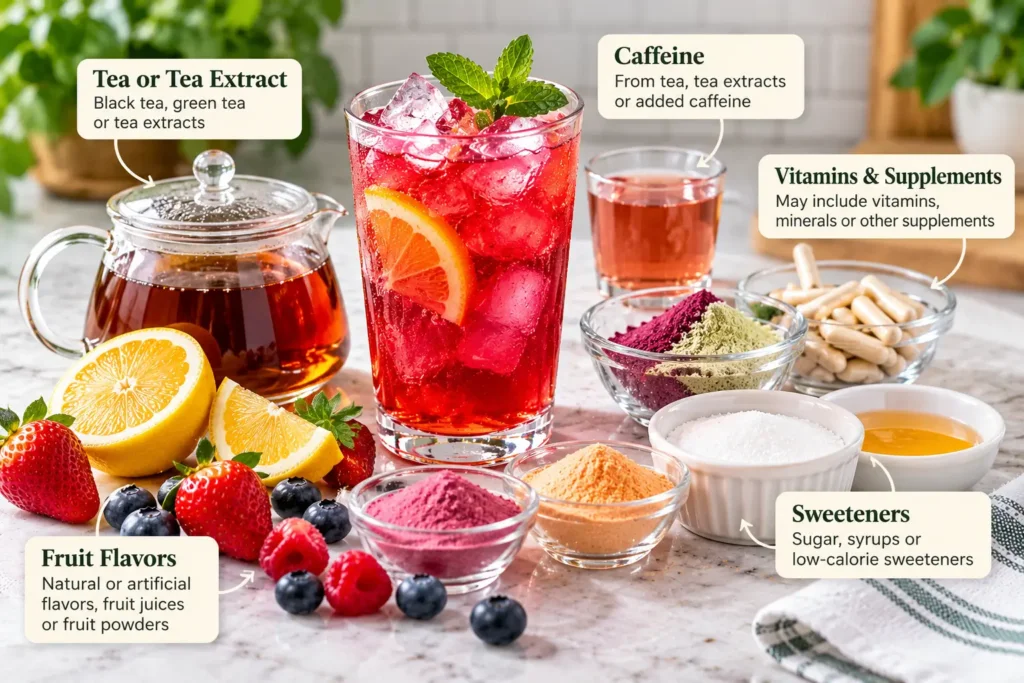
Tea or Tea Extract
Some loaded teas contain black tea, green tea, or concentrated tea extracts.
Black and green tea contain caffeine naturally. Decaffeinated versions generally contain less caffeine, but are not necessarily caffeine-free. A herbal base also needs an ingredient check, since a mixed product may add caffeine from elsewhere.
If you’re interested in traditional tea rather than a mixed energy-style beverage, our guide to black tea benefits explains more about regular brewed black tea.
Caffeine
Loaded teas are often associated with energy, and caffeine may be one reason.
Some formulas combine tea with other caffeine-containing ingredients. The NCCIH energy-drinks overview notes that guarana itself contains caffeine. A botanical source still contributes to the total; it is not a caffeine-free substitute.
This makes it difficult to estimate the caffeine content just by looking at the drink.
Flavorings
Fruit flavors are common.
A loaded tea might taste like peach, berry, citrus, tropical fruit, or a combination of several flavors.
The flavor can come from drink mixes, powders, syrups, concentrates, or other ingredients.
Sweeteners
Sweetness may come from sugar, honey, flavored syrups, non-sugar sweeteners or several sources together. Examples of non-sugar sweeteners that may appear on labels include stevia-derived sweeteners and sucralose. These are examples to look for, not ingredients present in every loaded tea.
Ask which sweeteners are used in the particular drink. Sugar-free does not mean caffeine-free, calorie-free in every formulation or automatically suitable for a medical condition. Juice, fruit and other additions can change the finished drink’s nutrition.
Vitamins and Supplements
Some versions include added vitamins or other supplemental ingredients.
The presence of vitamins doesn’t automatically make a beverage healthier, nor does it mean that consuming more provides additional benefits.
The complete ingredient list matters more than individual marketing terms.
Does Loaded Tea Have Caffeine?
Many loaded teas do contain caffeine, but there is no universal amount.
Caffeine may come from:
- black tea
- green tea
- tea extracts
- supplemental caffeine
- other caffeine-containing ingredients
That means one loaded tea could contain substantially more caffeine than another.
For comparison, ordinary brewed tea gets its caffeine naturally from the tea leaves and doesn’t require supplemental caffeine.
If you’re trying to reduce your intake, our guide to the best caffeine-free drinks provides alternatives that don’t depend on caffeine for their appeal.
How Much Caffeine Is in a Loaded Tea?
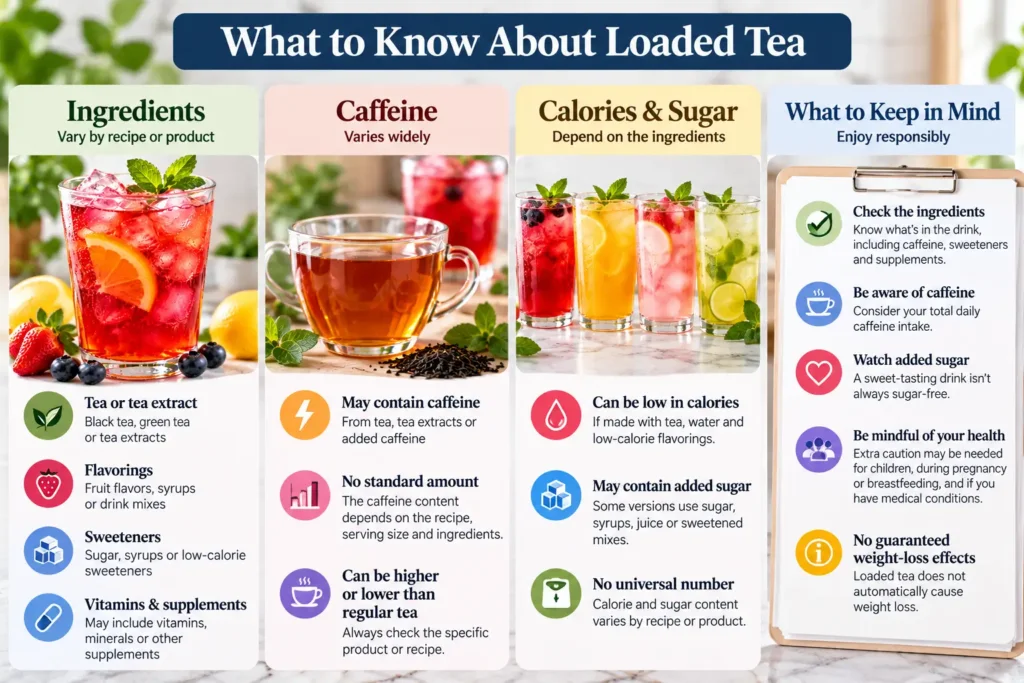
There isn’t a single reliable number that applies to every loaded tea.
The amount depends on the recipe, serving size, tea base, concentrates, and any additional caffeine-containing products used.
Ask for the total milligrams of caffeine in the complete serving, including the tea and every caffeinated mix. If the seller only gives the amount in one powder or scoop, you still do not know the amount in the final cup.
If you’re purchasing one from a shop, ask for the ingredient and caffeine information when available.
Check whether label figures describe one scoop, one serving or a whole container. Avoid double-counting when a manufacturer already reports total caffeine from all sources. If quantities or caffeine amounts are undisclosed, an accurate total cannot be calculated from appearance or drink size.
How to Add Up Caffeine From Several Ingredients
As a hypothetical example, a tea base contributing 30 mg plus a mix contributing 120 mg makes 150 mg in the batch, provided there are no other caffeine sources. Splitting that well-mixed batch equally into two servings gives 75 mg per serving. These numbers illustrate arithmetic; they are not measurements of a shop drink or the homemade recipe below.
The FDA caffeine guidance cites 400 mg per day for most adults as an amount not generally associated with negative effects. That is a daily total from all sources, not a target, a per-drink allowance or a guarantee for every person. Sensitivity, medications, pregnancy and health conditions can change what is appropriate.
Loaded Tea vs. Regular Tea
Loaded tea and traditional brewed tea can be very different beverages.
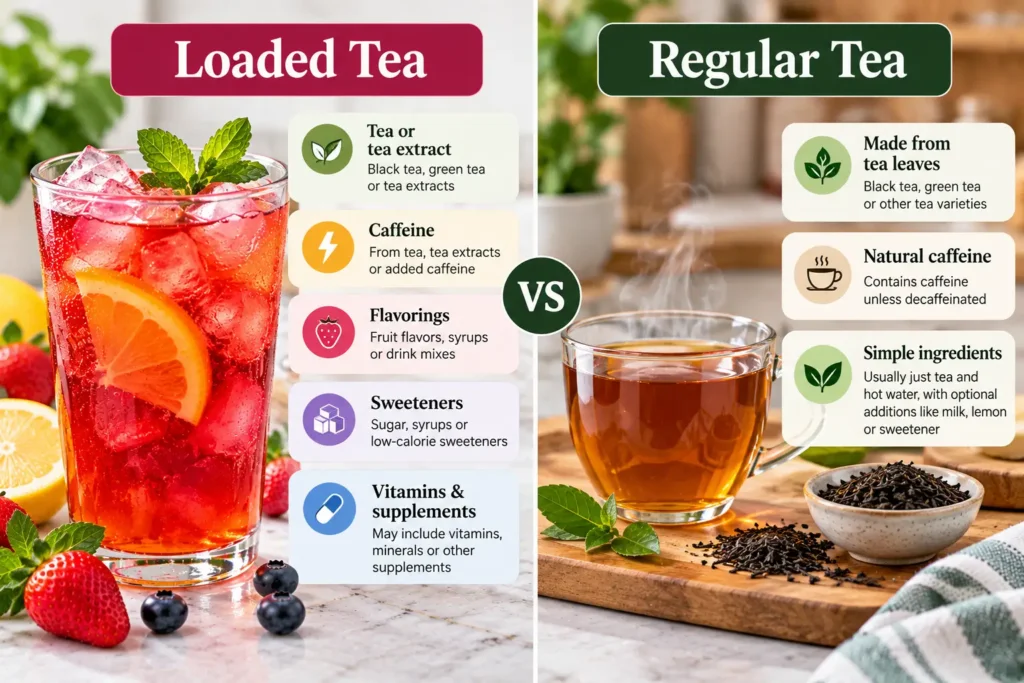
Regular Tea
Traditional tea is made by steeping leaves from Camellia sinensis in water.
Black tea and green tea are examples.
The drink may be consumed plain or with additions such as milk, lemon, or sweetener.
Loaded Tea
Loaded tea generally combines a tea component with multiple additional ingredients.
Those additions may significantly change the drink’s:
- caffeine content
- sweetness
- calorie content
- flavor
- nutritional profile
So while both beverages may contain tea, they shouldn’t automatically be considered nutritionally equivalent.
For a broader comparison of traditional teas and herbal infusions, see our herbal tea vs green tea benefits guide.
Are Loaded Teas Healthy?
There isn’t a simple yes-or-no answer because loaded teas vary so much.
A drink made primarily from brewed tea, water, and modest amounts of other ingredients is very different from a beverage containing high levels of caffeine, multiple supplements, syrups, and sweeteners.
Instead of relying on the word “loaded,” consider:
How much caffeine does it contain?
Does it contain added sugar?
What is the serving size?
Which supplements have been added?
How often are you drinking it?
Those questions provide much more useful information than the drink’s name.
How Many Calories Are in a Loaded Tea?
Again, there is no standard calorie count.
A drink made with tea, water, and low-calorie flavorings could contain relatively few calories.
Adding sugar, syrup, juice, or other caloric ingredients can increase that amount substantially.
Therefore, statements such as “loaded teas are low calorie” shouldn’t be applied to every recipe.
If calorie information matters to you, check the specific product or recipe rather than relying on a generic estimate.
Are Loaded Teas Sugar-Free?
Some are, but not all.
A loaded tea may use non-sugar sweeteners and contain little or no added sugar.
Others may contain:
- sugar
- flavored syrups
- sweetened concentrates
- juice
- drink mixes containing sugar
Examine the nutrition information for the complete finished drink, not just a claim about one powder. No added sugar and sugar-free are different claims; neither tells you the caffeine content. Ask whether fruit juice, syrup or optional toppings have been included.
Do Loaded Teas Give You Energy?
Loaded teas are frequently marketed or consumed as energy drinks.
When someone feels more alert after drinking one, caffeine may be an important reason.
Caffeine stimulates the central nervous system and can temporarily increase alertness.
That doesn’t mean the drink creates energy in a unique way or that more caffeine will necessarily produce better results.
Too much caffeine can cause unpleasant effects.
Loaded Tea Side Effects
Potential side effects depend largely on the ingredients.
For caffeine-containing versions, possible effects can include:
- jitteriness
- difficulty sleeping
- headache
- increased heart rate
- nervousness
- digestive discomfort
People vary considerably in their sensitivity to caffeine.
Combining a loaded tea with coffee, energy drinks, pre-workout products, or other caffeinated beverages can also increase total daily caffeine intake.
If caffeine tends to interfere with your sleep, choosing one of the best drinks for better sleep later in the day may make more sense than another caffeinated drink.
Can Loaded Tea Help With Weight Loss?
Loaded teas are sometimes associated with weight-loss marketing, but drinking a loaded tea does not automatically cause body-fat loss.
If a low-calorie loaded tea replaces a high-calorie beverage, the substitution could reduce overall calorie intake.
That’s different from the drink itself having a special fat-burning effect.
Caffeine can also temporarily influence alertness and metabolism, but that shouldn’t be interpreted as evidence that a particular loaded tea produces meaningful long-term weight loss.
Be especially cautious with products promising rapid weight loss, “fat burning,” or dramatic body changes.
Is Loaded Tea the Same as an Energy Drink?
Not exactly, although there can be overlap.
Traditional energy drinks are formulated specifically as caffeinated beverages and often provide clearly labeled caffeine information when packaged.
Loaded teas may use tea or tea extracts as part of their base and can contain a wider combination of flavorings and supplemental ingredients.
But a loaded tea containing substantial caffeine can function similarly to an energy drink in terms of its stimulant effects.
The label matters more than the name.
Loaded Tea vs. Herbal Tea
These drinks are also quite different.
Herbal tea is generally prepared by infusing herbs, flowers, roots, spices, or other plant material in water.
Many herbal teas are naturally caffeine-free, although that depends on the ingredients.
Loaded tea typically refers to a mixed beverage containing several additional components and often caffeine.
If you want to explore simpler botanical infusions, our herbal teas guide explains the major types and how they’re prepared.
Can You Make Loaded Tea at Home?
Yes, but first decide what you actually want from the drink.
If your goal is simply a refreshing flavored iced tea, you don’t need to reproduce a supplement-heavy commercial formula.
You can start with brewed black or green tea, chill it, add ice, and flavor it with fresh fruit or citrus.
For a caffeine-free starting point, choose an appropriate caffeine-free infusion instead of black or green tea. Our cold brew herbal tea recipes offer simpler alternatives. Keep the full ingredient list in mind when choosing a blend.
Avoid casually adding concentrated caffeine powders or combining multiple stimulant products.
A Simple Loaded-Tea-Inspired Drink
If you want a simpler alternative to supplement-heavy loaded teas, this homemade version uses brewed tea, fresh fruit, citrus, and optional sweetener. It isn’t intended to duplicate any commercial loaded tea formula.

What Is Loaded Tea? Ingredients, Caffeine, Calories & What to Know
A simple loaded tea-inspired iced drink made with brewed tea, fresh citrus, berries, ice, and optional sweetener. This homemade version keeps the ingredients easy to identify and does not use concentrated caffeine powders or supplement blends.
- Total Time: 10 minutes
- Yield: 2 servings 1x
Ingredients
- 1 black or green tea bag
- 1 cup hot water
- 1 cup cold water
- 1/2 cup ice cubes
- 2 tablespoons fresh lemon or lime juice
- 1/4 cup fresh berries, lightly crushed
- 1–2 teaspoons honey, maple syrup, or another sweetener, optional
- Fresh mint and citrus slices, optional, for serving
Instructions
- Place the tea bag in a heat-safe cup and pour 1 cup of hot water over it.
- Steep the tea according to the package directions, then remove the tea bag.
- Allow the brewed tea to cool for several minutes.
- Lightly crush the fresh berries in the bottom of a large glass or pitcher.
- Add the lemon or lime juice and optional sweetener.
- Pour in the brewed tea and 1 cup of cold water. Stir well.
- Fill a serving glass with ice and pour the tea mixture over the ice.
- Garnish with fresh mint and citrus slices, if desired.
- Serve immediately.
Notes
This is a simple loaded tea-inspired drink, not a copycat recipe for any commercial loaded tea. Black and green tea naturally contain caffeine. The amount varies according to the type of tea, brand, serving size, and brewing method. For a caffeine-free version, use a caffeine-free herbal infusion instead of black or green tea. Adjust the sweetness to taste or omit the sweetener entirely. Do not add concentrated caffeine powder or combine multiple stimulant products in an attempt to reproduce highly caffeinated commercial drinks. The color and flavor will vary depending on the berries and tea you use.
- Prep Time: 5 minutes
- Cook Time: 5 minutes
- Category: Drinks
- Method: Steeping
- Cuisine: American-Inspired
Keywords: loaded tea, loaded tea recipe, loaded tea inspired drink, homemade loaded tea, iced tea, fruit tea
How to Choose a Loaded Tea
Before ordering, ask: What products and quantities go into this drink? How much caffeine is in the whole serving? Which sweeteners are used? Is the nutrition information for this cup size? A flavor name alone is not enough information.
Look for information about:
Caffeine
Knowing the caffeine amount is particularly important if you also drink coffee, tea, or energy drinks.
Added Sugar
Check whether sweetness comes from sugar, syrups, juice, or non-sugar sweeteners.
Supplements
Find out which vitamins, herbs, extracts, or other supplemental ingredients have been added.
Serving Size
A large drink can contain more caffeine and other ingredients than you might expect from a standard cup of tea.
Ingredient transparency is particularly valuable with drinks containing multiple components.
Who Should Be Careful With Loaded Tea?
People who are particularly sensitive to caffeine should check the caffeine content carefully.
Children and adolescents should avoid energy drinks. During pregnancy or breastfeeding, or when taking medication or managing a condition affected by stimulants, have the actual ingredients and quantities reviewed by your healthcare professional rather than relying on general loaded-tea advice.
Because loaded tea formulas vary, a healthcare professional can only evaluate potential concerns accurately when the actual ingredient list is known.
FAQS
What is a loaded tea?
A loaded tea is generally a flavored tea-based beverage containing additional ingredients that may include caffeine, flavorings, sweeteners, vitamins, and supplements. There is no single standardized loaded tea recipe.
What is in loaded tea?
Possible ingredients include tea or tea extract, caffeine-containing mixes, flavoring, sweeteners, vitamins and other supplements, plus water and ice. There is no single standard ingredient list. Ask for the actual products and amounts used in your drink.
Does loaded tea have caffeine?
Many loaded teas contain caffeine, but the amount varies. Caffeine may come from tea, tea extracts, or additional caffeine-containing ingredients.
How much caffeine is in loaded tea?
There is no universal amount. Ask for the total caffeine in the complete serving from every ingredient. Check whether a label refers to a scoop, a portion or the whole drink; size and color cannot establish the amount.
How many calories are in loaded tea?
Calories depend on the ingredients. Some versions may be relatively low in calories, while sugar, juice, and syrups can increase the calorie content.
Is loaded tea sugar-free?
Some versions use low- or zero-calorie sweeteners, while others contain sugar or sweetened ingredients. Check the specific drink.
Are loaded teas healthy?
Their nutritional profiles vary too much for all loaded teas to be classified the same way. Consider caffeine, added sugar, serving size, and supplemental ingredients individually.
Does loaded tea help you lose weight?
There is no good reason to assume that a beverage causes meaningful fat loss simply because it is marketed as a loaded tea. Replacing a higher-calorie drink with a lower-calorie beverage may reduce calorie intake, but that’s different from a special fat-burning effect.
Can I drink loaded tea every day?
That depends primarily on its caffeine content and other ingredients, as well as your overall diet, medications, health circumstances, and other sources of caffeine.
Is loaded tea the same as regular tea?
No. Regular tea can simply consist of tea leaves and water, while loaded tea generally contains multiple additional ingredients.
What is loaded tea sweetened with?
It depends on the formula. Some use sugar, honey or syrups; others use non-sugar sweeteners such as stevia-derived sweeteners or sucralose. A drink may combine several sources. Check the specific ingredient list instead of assuming all loaded teas use the same sweetener.
Choosing a Loaded Tea With Clear Information
Loaded tea isn’t one standardized beverage.
It’s a broad name used for tea-based drinks that may contain caffeine, flavorings, sweeteners, vitamins, supplements, and other ingredients.
That means the most useful question isn’t simply whether loaded tea is “healthy.”
Instead, look at what’s actually in the specific drink, particularly its caffeine, sugar, serving size, and supplemental ingredients.
If you enjoy the flavor but want more control over what you’re consuming, a homemade iced tea made with brewed tea, fruit, citrus, and optional sweetener can provide a much simpler alternative.