
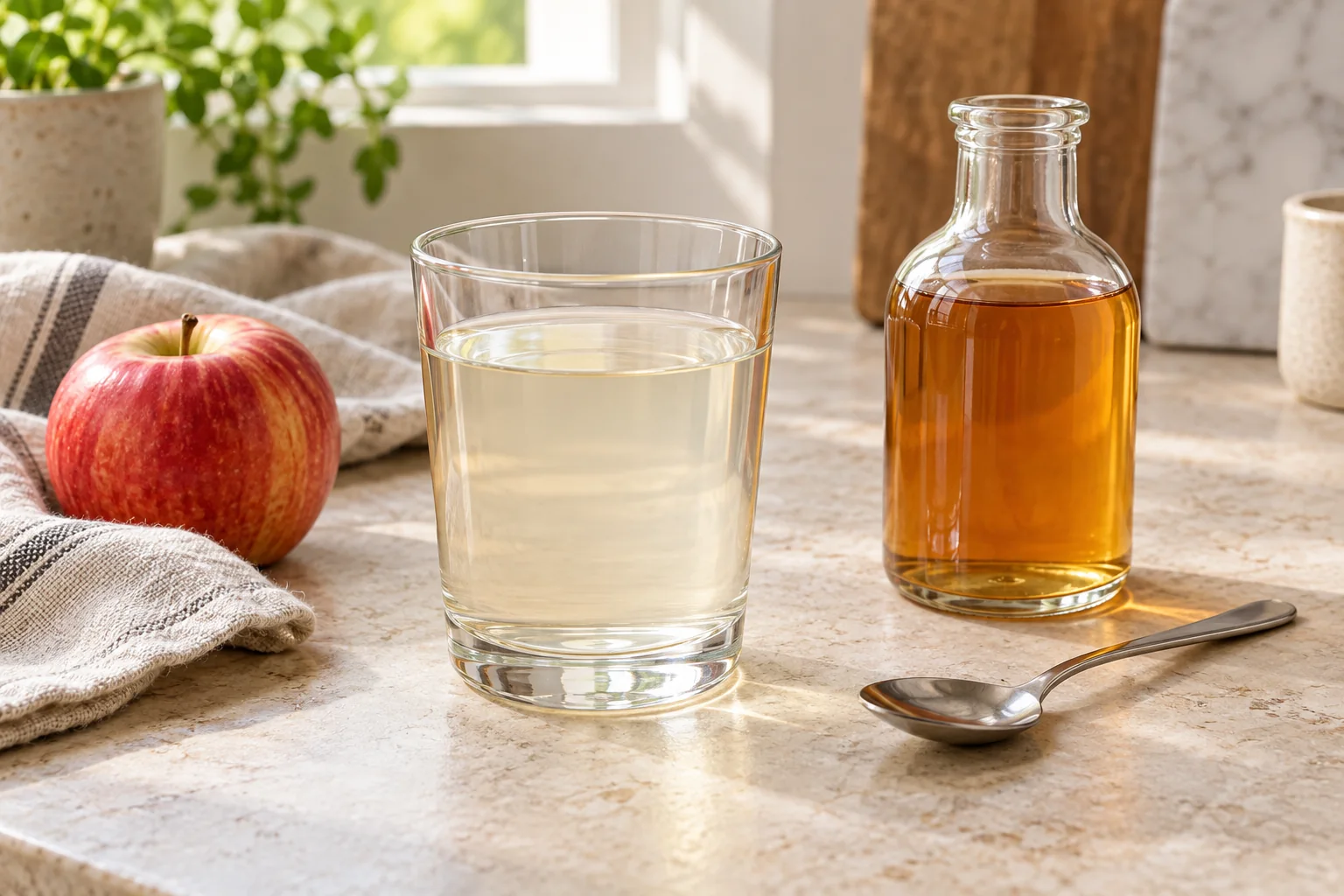
An apple cider vinegar drink for weight loss is usually vinegar mixed with water, sometimes with sweeteners or spices. It is not a proven way to produce meaningful, lasting weight loss or target belly fat. If you enjoy its sour taste, the recipe below makes a small culinary amount into a diluted drink, without presenting it as a treatment or a daily weight-loss prescription.
The distinction matters because an easy recipe and an effective weight-management method are different things. You can decide whether you like a tart beverage without expecting it to change your metabolism. There is also no need to drink vinegar at all: using it in a salad dressing is another way to enjoy the ingredient.
Apple Cider Vinegar Drink: Quick Recipe
For one serving, stir 1 teaspoon (5 ml) of food-grade apple cider vinegar into 1 1/4 cups (300 ml) of cold or room-temperature water. Ice is optional. This ratio is a recipe choice for a relatively mild flavor, not a clinically established weight-loss dose. Dilution does not make an acidic drink risk-free.
The recipe takes about two minutes and requires no cooking. It contains no lemon juice, baking soda, honey or supplement powder. Leaving those ingredients out keeps the taste simple and avoids suggesting that a more complicated mixture burns more fat.
What Is Apple Cider Vinegar?
Apple cider vinegar is a fermented apple product whose sourness comes mainly from acetic acid. Commercial culinary versions commonly list an acidity level on the label. The flavor is sharper than apple juice and it should not be treated like a glass of cider. A teaspoon changes the taste of water even though it is a small amount.
Some bottles contain visible sediment described as the “mother.” That feature does not establish a weight-loss advantage. A cloudy bottle, a premium price or organic certification also does not show that a product reduces body fat. Choose an ingredient for its food use and flavor rather than a promise on the front of the bottle.
Ingredients and Equipment
- 1 1/4 cups (300 ml) drinking water, cold or room temperature
- 1 teaspoon (5 ml) food-grade apple cider vinegar, following the product label
- Ice, optional
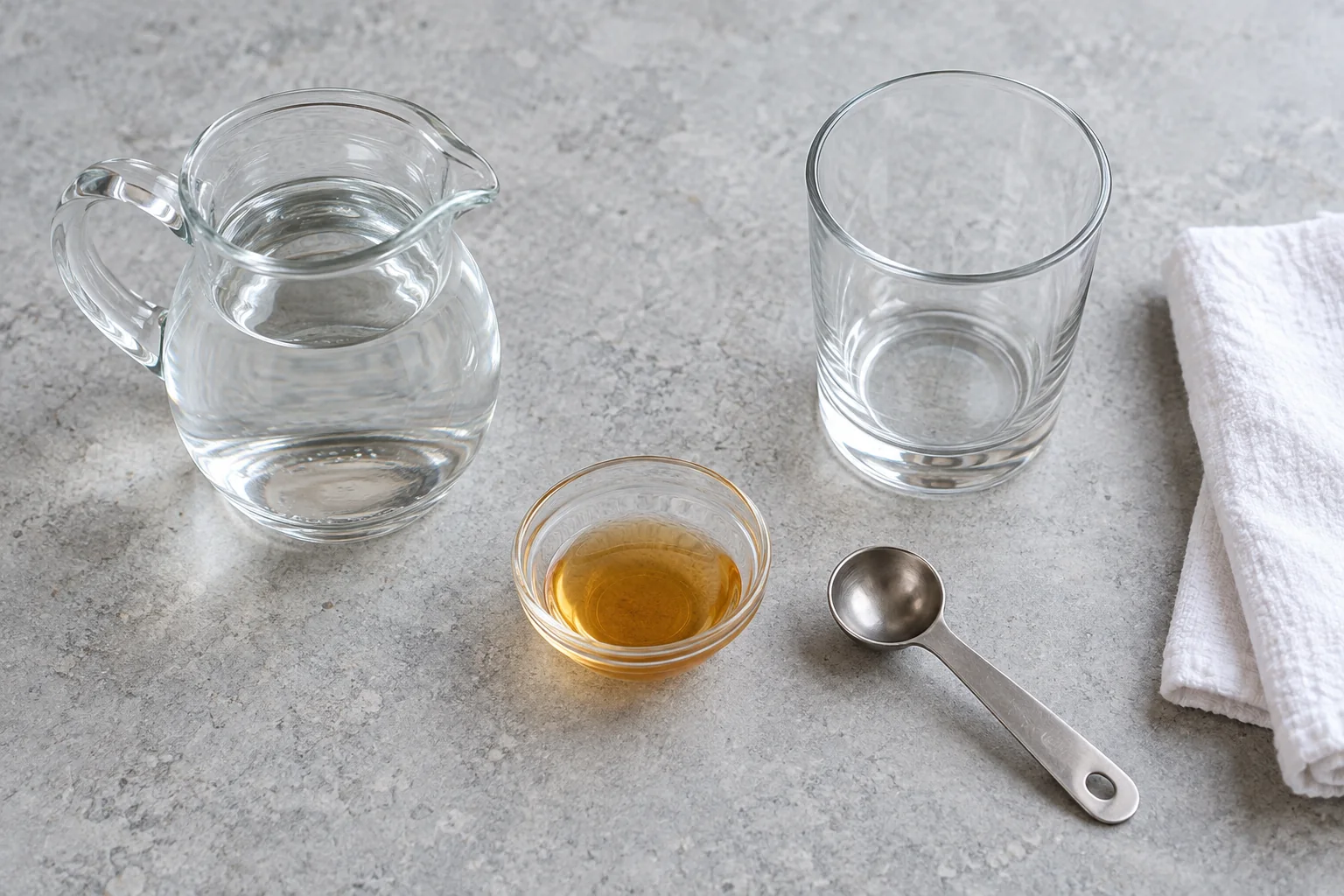
- One drinking glass, a measuring teaspoon and a spoon
Use vinegar sold for culinary use, not cleaning vinegar or concentrated acetic acid. Check the label before measuring. If it has an unusually high acidity or instructions that differ from ordinary food vinegar, do not assume this recipe applies. An unlabelled bottle is not a useful substitute when you cannot verify what it contains.
A measuring teaspoon helps keep the recipe consistent. Pouring directly from a large bottle makes it easy to add far more than intended, especially when the liquid looks similar to apple juice. Measure the vinegar separately and keep the bottle away from children.
How to Make the Drink
- Pour 300 ml of drinking water into a clean glass, leaving room for ice if you want it.
- Measure 1 teaspoon of culinary apple cider vinegar and stir it into the water. Do not drink the measured vinegar by itself.
- Taste a small amount. Add more water if you want a milder flavor; do not add more vinegar to chase a stronger effect.
- Add optional ice and serve. If it causes burning, nausea or reflux symptoms, stop drinking it rather than forcing yourself to finish.
Apple Cider Vinegar Drink for Weight Loss: Recipe, Evidence & Safety
A simple tart drink made with culinary apple cider vinegar and water. This recipe is a beverage option, not a proven weight-loss treatment.
- Total Time: 2 minutes
- Yield: 1 serving 1x
Ingredients
- 1 1/4 cups (300 ml) drinking water, cold or room temperature
- 1 teaspoon (5 ml) food-grade apple cider vinegar
- Ice, optional
Instructions
- Pour the water into a clean drinking glass, leaving room for ice if desired.
- Measure the apple cider vinegar and stir it into the water. Do not drink the vinegar undiluted.
- Taste a small amount and add more water if you prefer a milder flavor.
- Add optional ice and serve. Stop drinking if it causes burning, nausea or reflux symptoms.
Notes
The vinegar quantity is a culinary recipe measurement, not an established weight-loss dose. Dilution does not eliminate acidity or the risk of irritation. Use culinary vinegar, never cleaning vinegar or concentrated acetic acid. This drink is optional and is not a meal replacement.
- Prep Time: 2 minutes
- Cook Time: 0 minutes
- Category: Drinks
- Method: No-cook
Nutrition
- Serving Size: Entire recipe
Keywords: apple cider vinegar drink, diluted apple cider vinegar, apple cider vinegar drink recipe
The finished drink should be pale and watery, with a noticeable sour smell. It should not be thick, foamy or syrupy. Some sediment can come from an unfiltered vinegar; follow its label about shaking. The appearance is not a test of whether the drink has any effect on weight.
For more than one person, multiply the water and vinegar together and measure each ingredient. Two servings would use 600 ml of water and 2 teaspoons of vinegar. This is batch scaling for a recipe, not a recommendation for one person to drink multiple servings.
Does Apple Cider Vinegar Help With Weight Loss?
The evidence does not justify promising that this drink will cause meaningful, sustained weight loss. Small studies and short follow-up periods cannot tell us that a homemade mixture will work for everyone or that any change will persist. A result measured in a particular trial also does not validate a social-media recipe containing different ingredients.
An older randomized trial of vinegar in Japanese adults reported changes in weight and other measurements over 12 weeks. It studied specified vinegar beverages under defined conditions. It does not establish the effectiveness of this one-teaspoon recipe, prove permanent results or show that one apple cider vinegar brand is superior.
It is useful to separate possible research signals from practical advice. A study can raise a question worth investigating without giving readers a reliable treatment plan. It can also measure outcomes such as blood lipids or glucose that are different from long-term fat loss. One outcome should not be substituted for another.
The Retracted Weight-Loss Study
A widely publicized 2024 trial of apple cider vinegar and weight management was retracted in September 2025. BMJ Group explains that problems included unreliable data and statistical analysis. Its reported weight-loss results should not be used as evidence that vinegar works.
That correction matters when reading older articles, videos and product descriptions. A dramatic number repeated in many places can still come from the same unreliable source. Repetition is not independent confirmation, and an attractive before-and-after image is not a substitute for a trustworthy study.
The retraction does not answer every question about every vinegar study. It does mean that this particular trial cannot support promises about how much weight you will lose, how quickly it will happen or what amount you should take. This recipe does not rely on those claims.
Can It Reduce Belly Fat or Work in One Week?
This drink has not been established as a way to selectively reduce belly fat. Nor is there a reliable one-week result you can expect from the recipe. “Belly fat,” body weight, waist measurements and temporary bloating describe different things; a change in one is not proof of a change in all the others.
Avoid interpreting a rapid change on the bathroom scale as evidence that an ingredient has burned fat. A personal experiment does not control for changes in meals, activity, fluid balance or measurement conditions. There is no reason to increase the vinegar when a promised deadline passes without the result a video suggested.
If your goal is to evaluate broader beverage claims, the guide to ginger tea and weight loss takes the same practical approach: distinguish a drink you enjoy from evidence that an ingredient produces weight loss. Neither drink needs to become a mandatory ritual.
How Much Apple Cider Vinegar Should You Use?
The amount in this recipe is 1 teaspoon in 300 ml of water. It is not a recommended medical dose or a daily target. You do not need to progress to tablespoons, add a second serving or make the mixture more concentrated. A stronger sour taste is not evidence of a stronger weight-loss effect.
Amounts used in research should be described as study details rather than copied into a universal schedule. Different products, participants, study lengths and health conditions make that shortcut unreliable. If you want advice about regular use with a medical condition or medicine, ask your clinician or pharmacist about your situation.
Best Time to Drink It: Morning, Before Meals or at Night?
There is no established best time for this particular recipe to cause weight loss. Morning, before dinner and bedtime versions belong in the same discussion rather than being treated as separate fat-burning methods. Scheduling a drink does not resolve the limitations of the evidence.
Do not force it on an empty stomach if that feels unpleasant, and do not turn bedtime into a required vinegar routine. If the drink brings on symptoms, changing the clock time is not a reason to keep taking it. You can simply choose water instead.
Meal planning and drinking routines can be practical without becoming rigid. For example, preparing a glass of water when you make lunch is an easy habit. Adding vinegar is optional and has not been shown to be the essential part of that habit.
Flavor Changes and What They Actually Do
| Addition or change | What it changes | What it does not establish |
|---|---|---|
| More water | A less intense sour taste | A guarantee that the drink cannot irritate teeth or digestion |
| Ice or cool water | Temperature and serving preference | A special calorie-burning effect |
| Honey or syrup | Sweetness and added sugar | An improvement in vinegar’s weight-loss effectiveness |
| Lemon juice | More citrus flavor and acidity | A targeted belly-fat benefit |
| Baking soda | Reacts with the vinegar and changes the mixture | A validated weight-loss or detox treatment |
| Cinnamon or ginger | Flavor, depending on how it is prepared | Proof that a multi-ingredient mixture is more effective |
If you dislike the flavor unless you add a lot of sugar, there is little reason to make yourself drink it. Plain water or another unsweetened beverage may suit you better. The recipe is an option for someone who likes a tart taste, not a test of discipline or a requirement for a healthier routine.
For a completely different flavor, you can prepare cold-brew herbal tea instead. Those recipes are alternatives for variety; they are not presented here as equivalent weight-loss treatments. Choose ingredients that suit your preferences and health needs.
Liquid Vinegar vs. Gummies, Pills and Capsules
A liquid ingredient, a gummy and a capsule are not interchangeable simply because their labels mention apple cider vinegar. Serving sizes, actual contents, sweeteners and formulation differ. Findings about one liquid product should not be used as proof that a gummy or pill produces the same result.
A sensible comparison starts with the full ingredient list and the amount per serving, not a claimed number of pounds lost. Be cautious with “equivalent to” wording that does not explain what is being compared. This article does not rank brands or recommend buying a supplement for weight loss.
Do not dissolve capsules or crush tablets into the drink to imitate the recipe. Food vinegar is the ingredient specified here. If a supplement has been prescribed or recommended for you, use it only as directed and ask a pharmacist before changing how you take it.
Side Effects and Who Should Be Cautious
Vinegar remains acidic after dilution. Regular exposure to acidic drinks can contribute to enamel erosion, and dilution is not a guarantee of dental safety. The American Dental Association explains how dietary acids can damage teeth. Avoid swishing the drink around your mouth or sipping it continuously over many hours.
Apple cider vinegar can irritate the throat and may interact with medicines, including insulin and some diuretics, with concerns about potassium. Mayo Clinic discusses these risks. Ask your pharmacist before regular use if you take medicines or have a condition affecting digestion or potassium.
Stop if it causes discomfort. Do not treat pain, nausea or burning as signs that the drink is “working.” For pregnancy, children or a medically supervised diet, do not adopt a weight-loss vinegar routine without individual professional advice. Using a small amount in food is a different situation from taking it as a repeated remedy.
Storage and Serving
Mix only what you plan to serve. Follow the vinegar bottle’s own storage instructions and use clean utensils. There is no benefit to making a large week-long “detox” batch, and this recipe has not been tested to establish a storage life for a prepared mixture with extra ingredients.
If you add fresh produce or another ingredient, that changes the recipe and its handling needs. Do not assume vinegar turns a homemade beverage into a preserved product. For a single serving, measuring and stirring take so little time that a fresh glass is the simplest option.
What Matters More for Weight Management?
A drink cannot replace a sustainable eating pattern, appropriate activity, sleep and individualized care. The NIDDK guide to choosing a weight-management program emphasizes realistic habits and ongoing support. If weight is affecting your health, a qualified professional can help you choose an approach suited to your needs.
One practical beverage decision is to look at what you actually drink during a normal week. If you regularly choose heavily sweetened drinks, consider an unsweetened option you enjoy. Any benefit from reducing added sugar or overall energy intake should not be credited automatically to vinegar.
If you enjoy tea, my hibiscus tea weight-loss guide explains another popular drink claim. You can also use the daily water guide to think about hydration without treating sourness, herbs or a particular clock time as necessary.
FAQS
Does apple cider vinegar help you lose weight?
Reliable evidence is insufficient to promise meaningful, sustained weight loss from this drink. Small studies do not establish a dependable result for a homemade recipe, and a widely publicized 2024 trial was retracted in 2025.
How do you make an apple cider vinegar drink?
For this recipe, stir 1 teaspoon (5 ml) of food-grade apple cider vinegar into 1 1/4 cups (300 ml) of water. Add optional ice. This is a culinary ratio, not an established weight-loss dose.
How much apple cider vinegar should I drink for weight loss?
There is no universally established weight-loss dose. The teaspoon used in this recipe is not a daily target or a reason to increase your intake. Ask a clinician or pharmacist about regular use if you have health conditions or take medicines.
Can apple cider vinegar reduce belly fat?
This recipe has not been shown to selectively reduce belly fat. A change in bloating or a short-term scale reading is not proof that the drink has reduced abdominal fat.
Can I lose weight with apple cider vinegar in one week?
There is no reliable one-week weight-loss result established for this drink. Do not increase the concentration or frequency to meet a deadline advertised online.
Is morning or night better for apple cider vinegar?
No established timing makes this recipe an effective weight-loss treatment. Choose a different drink if vinegar causes discomfort, rather than forcing a morning or bedtime routine.
Are apple cider vinegar gummies better than liquid?
They are different products with different ingredients and amounts. Evidence about a liquid vinegar cannot establish that gummies are effective, and this article does not recommend supplements for weight loss.
Should I add baking soda or lemon?
Neither is needed in this recipe. Baking soda reacts with vinegar, and lemon adds acidity. Neither addition turns the mixture into a validated weight-loss drink.
Can I drink apple cider vinegar straight?
Do not drink the measured vinegar undiluted for this recipe. Even the diluted version remains acidic and may cause irritation. Using vinegar as a food ingredient is another option.
Does vinegar with the mother work better?
Visible sediment or a label mentioning the mother does not establish a weight-loss advantage. Choose a culinary vinegar for its suitability and flavor rather than assuming a cloudy product works better.
2 thoughts on “Apple Cider Vinegar Drink for Weight Loss: Recipe, Evidence & Safety”