
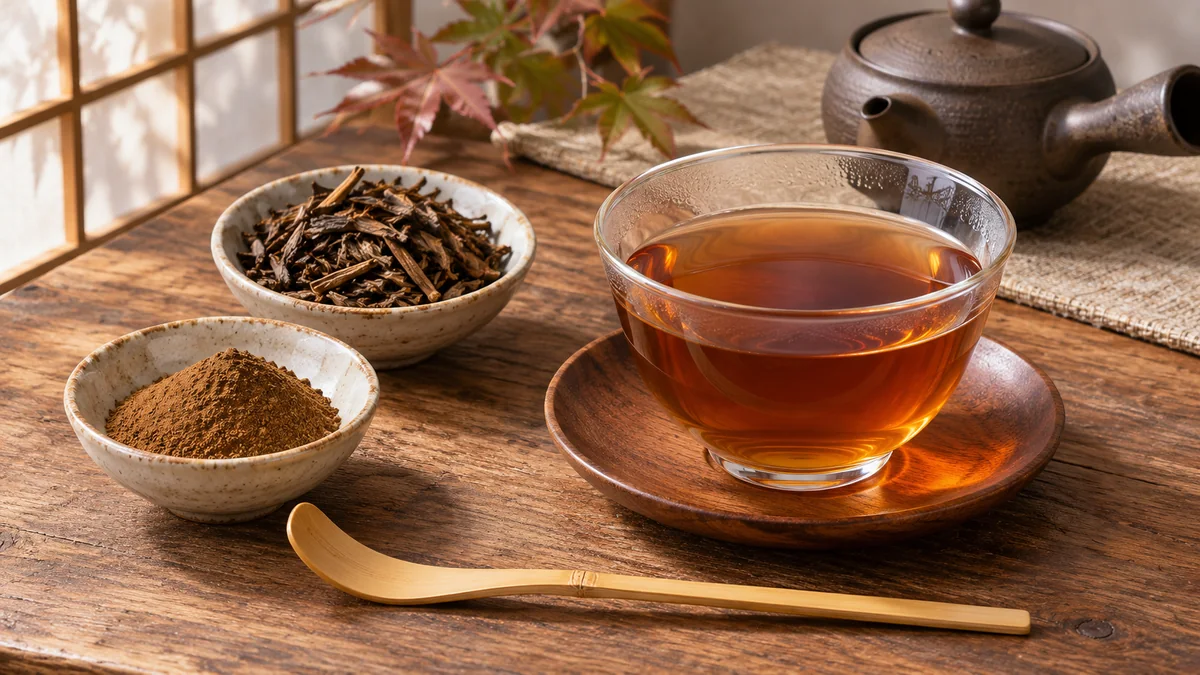
Hojicha contains caffeine. It is a roasted Japanese green tea, not a caffeine-free herbal infusion. Its actual caffeine level varies with the leaf or stem material, how much tea you use, infusion conditions and whether you drink a brewed infusion or a latte made from whole powdered hojicha. That is why one website may claim fewer than 10 mg a cup while another gives 40–50 mg.
Short answer: Japan’s official food-composition tables list 20 mg caffeine per 100 ml of brewed hojicha under a specified infusion method. That translates mathematically to about 30 mg per 150 ml, 40 mg per 200 ml or 48 mg per 240 ml when the same tested concentration applies. Your own weaker infusion may differ substantially, and a powder-based hojicha latte is not measured by the same infusion table.
If you’re looking for a recipe rather than caffeine analysis, our iced hojicha latte recipe provides a café-style preparation. This article focuses on evidence, calculations and useful comparisons.
Does Hojicha Have Caffeine?
Yes. Hojicha (also spelled hoji-cha or houjicha) is made by roasting green tea leaves, stems or a mixture of the two. Because the source plant is Camellia sinensis, caffeine may remain after roasting. Some hojicha products are lower in caffeine than many matcha preparations, but “roasted” and “caffeine-free” are not synonyms.
Leaf maturity matters. Products using mature bancha leaves or stems such as kukicha can start with different caffeine levels than teas made from tender young leaves. The roast, particle size, water temperature, steeping time and serving size also influence the concentration in the cup.
How Much Caffeine Is in Hojicha Tea?
The official Japanese MEXT Food Composition Database (hojicha infusion, food no. 16040) provides an important reference: 20 mg caffeine per 100 ml of brewed hojicha under an official protocol involving 15 g tea and 650 ml water at 90°C for 30 seconds. This is a measured reference under those conditions; it is not a universal guarantee for any tea bag or weak brew.
| Volume of brewed hojicha | Calculated caffeine at MEXT reference concentration | How to read it |
|---|---|---|
| 100 ml / 3.4 fl oz | 20 mg | Official reference concentration |
| 150 ml / 5.1 fl oz | 30 mg | Calculated from 20 mg / 100 ml |
| 200 ml / 6.8 fl oz | 40 mg | Calculated from same concentration |
| 240 ml / 8.1 fl oz | 48 mg | Illustrative cup conversion |
| 350 ml / 11.8 fl oz | 70 mg | Only if the concentration remains identical |
These numbers are arithmetic extensions of one standard laboratory preparation, not separate measurements of every cup size. For the original composition record and preparation method, consult the MEXT food-composition entry. An English-language comparison by the Japan Hojicha Association summarizes the results and testing conditions.
Why Do Some Websites Say Hojicha Has Only 7.7 mg?
Very low figures such as 7–15 mg per cup are widely repeated online, sometimes without the leaf quantity, test method or source. A light stem-dominant brew made with relatively little tea can indeed be milder than a concentrated leaf-based preparation. But a stand-alone “7.7 mg per cup” number is not a reliable universal description if the cup size, preparation and laboratory evidence are missing.
Rather than treating low and high estimates as a contradiction that must have one winner, check the variables: Was the sample roasted stems or leaves? Two grams or fifteen? Short infusion or whole powder? How large was the beverage? Did the number refer to the tea itself, or a diluted latte with milk? Without those details, the comparison is not meaningful.
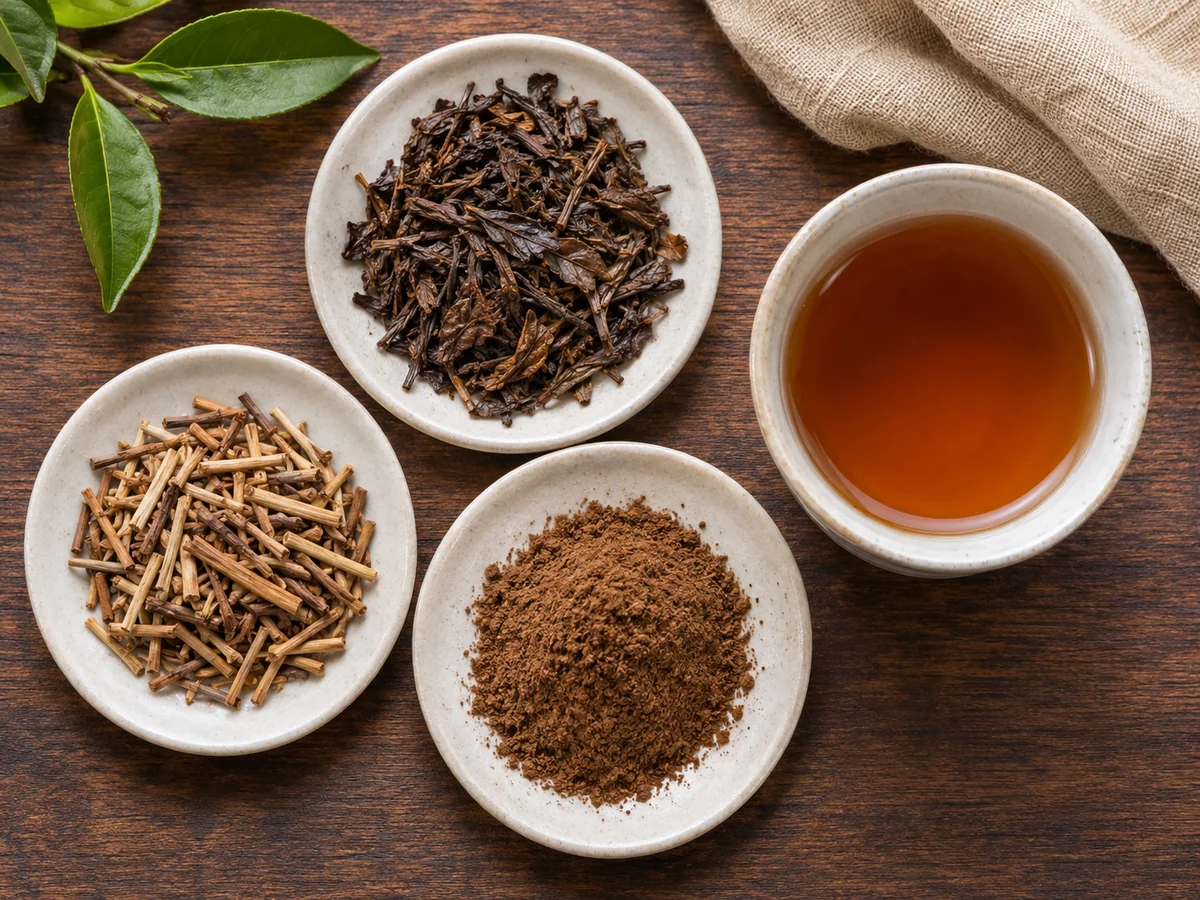
Hojicha Caffeine by Type: Leaves, Stems and Powder
| Form | Likely practical pattern | Best interpretation |
|---|---|---|
| Stem-heavy kuki-hojicha, gently brewed | May have less caffeine than a strong leaf-heavy brew | No universal milligram count without brand or lab results |
| Loose-leaf hojicha | Depends on leaf and steeping conditions | MEXT reference gives 20 mg / 100 ml for its official method |
| Roasted hojicha tea bag | Depends on amount and brewing instructions | Check pack weight, water volume and brew time |
| Whole hojicha powder | Entire measured powder is consumed | Content depends on mg caffeine per gram of that powder |
| Commercial hojicha latte | Tea or powder plus milk, often sweetener | Milk adds volume, not necessarily less total caffeine |
How Much Caffeine Is in a Hojicha Latte?
A brewed-tea latte and a whole-powder latte are fundamentally different. A brewed latte adds milk to an infusion; its caffeine comes from the extracted caffeine in the tea liquid. A powder latte consumes the entire powder, so the caffeine is approximately grams of powder × caffeine per gram for that product. The milk does not erase the caffeine.
As an illustration, if a manufacturer’s analyzed powder contained 8–17.5 mg caffeine per gram, a 2 g latte would contain approximately 16–35 mg and a 4 g latte approximately 32–70 mg. Those are conditional calculations from an example concentration, not official MEXT values for all hojicha powders. Different powders can fall outside that range. Ask the supplier for batch or product testing if you need a more precise number.
| Drink | Example tea material | Caffeine estimate |
|---|---|---|
| Standard brewed hojicha | MEXT official infusion | 20 mg/100 ml |
| Small whole-powder latte | 2 g powder at illustrative 8–17.5 mg/g | 16–35 mg (not universal) |
| Large whole-powder latte | 4 g same illustrative powder | 32–70 mg (not universal) |
| Decaffeinated coffee, 8 fl oz | Commercial coffee varies | Low, not necessarily zero |
| Regular brewed coffee, 8 fl oz | Typical US reference | About 95 mg, can vary |
Hojicha vs Matcha vs Sencha vs Coffee
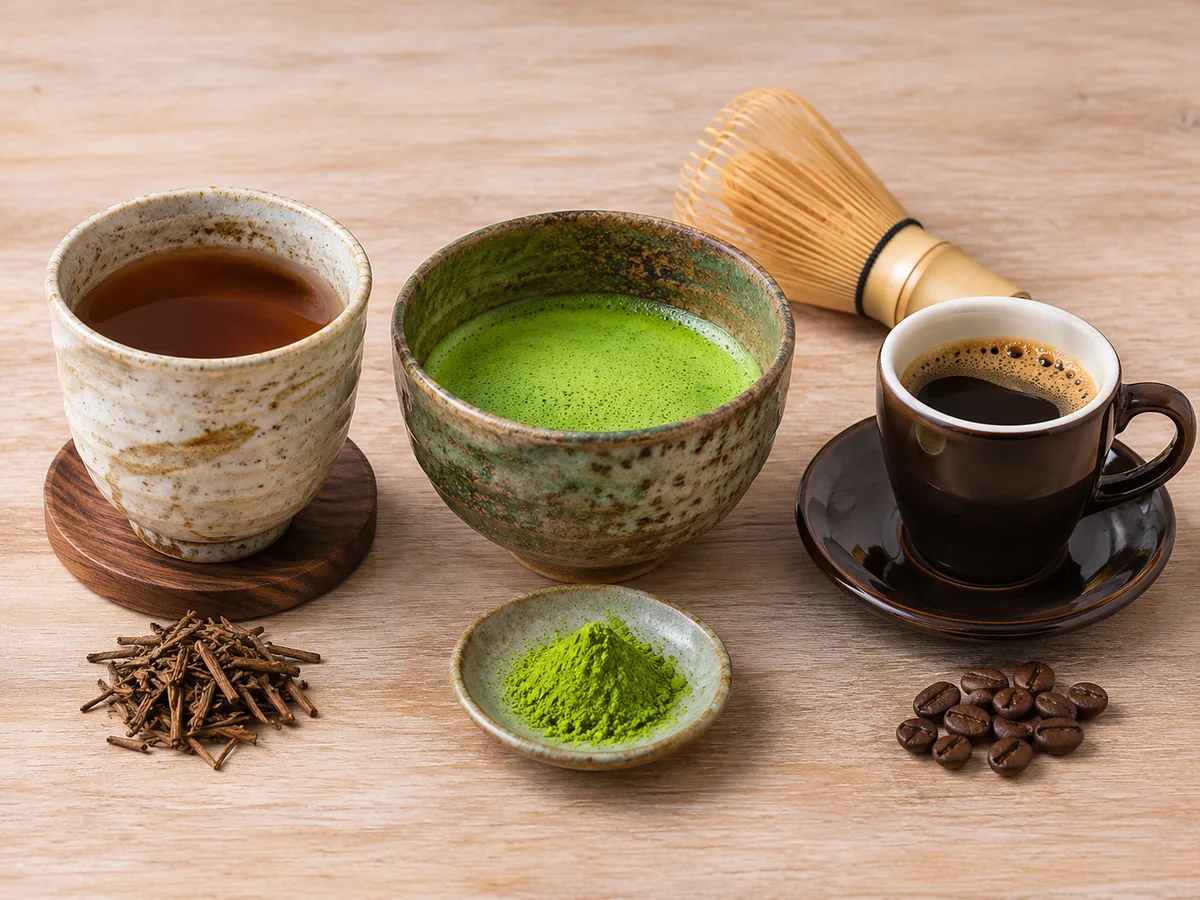
Matcha is shade-grown tea leaf milled to powder; when you drink matcha, you consume the leaf itself. Hojicha is roasted tea that may be brewed and strained or whisked as whole powder. For a 2 g serving of matcha, a commonly quoted composition value around 3.2 g caffeine per 100 g powder would calculate to roughly 64 mg, but products differ. Sencha is usually brewed and strained. Comparing a cup of hojicha tea with a latte containing several grams of matcha without stating the methods can mislead.
| Drink | Useful reference | Important caveat |
|---|---|---|
| Hojicha infusion | 20 mg / 100 ml (MEXT conditions) | Not every brew has that concentration |
| Sencha infusion | 20 mg / 100 ml in the cited Japanese standard table | Different testing protocol |
| Genmaicha infusion | 10 mg / 100 ml in cited Japanese standard table | Recipe and rice-to-leaf ratio vary |
| Matcha powder | Approx. 64 mg for 2 g at 3.2% caffeine by weight | Illustrative calculation, not batch testing |
| Brewed coffee | Approx. 95 mg per 8 fl oz typical reference | Roast, origin and brewing method vary |
For additional background on traditional tea caffeine and how it compares with coffee, see does green tea have caffeine? and matcha vs coffee.
If you would rather make an espresso-based latte than a roasted-tea drink, try our pandan coconut latte recipe. Its caffeine comes from espresso, so compare the actual coffee serving rather than assuming the caffeine level is similar to hojicha.
Does Roasting Remove the Caffeine From Hojicha?
Roasting alters aroma compounds, color and the composition of tea leaves. It may reduce some caffeine under some processing conditions, but the statement “roasting burns all the caffeine off” is false. The often-cited temperature around 178°C refers to caffeine’s behavior under particular physical conditions and is not a simple universal “boiling point at which all caffeine disappears from the tea.” Caffeine also has a higher melting point; a tea leaf is a complex mixture, not a beaker of pure caffeine.
More importantly, a lower caffeine measurement in one roasted tea can also reflect its raw material: mature leaves and stems may start with different caffeine levels. Roasting can change some catechins and other tea components, but it should not be marketed as a guarantee that hojicha has a specific therapeutic effect on sleep or stress.
How to Brew Hojicha for a Milder Cup
If your goal is to limit caffeine rather than eliminate it entirely, start with a stem-heavy kuki-hojicha where available, use a smaller tea quantity (for example, 2 g in a 240 ml cup) and try a short infusion, around 30–60 seconds. Lower concentration usually means less caffeine in the finished beverage, although the exact reduction cannot be quantified without testing. A cold brew may taste gentler, but cold brewing is not a guaranteed caffeine-removal method.
For a latte, consider brewed tea rather than consuming multiple grams of whole powder when you want tighter control over concentration. Use a smaller portion, read the product label and avoid adding another caffeinated ingredient. If you want zero tea caffeine, choose a genuine herbal or grain infusion without added tea, such as an unsweetened roasted-barley infusion, and check allergy information.
Is Hojicha a Good Evening Tea?
Some people tolerate a modest cup of hojicha in the afternoon. People who are caffeine-sensitive can still notice sleep disturbances from a low-caffeine tea, especially near bedtime. Your own cutoff depends on sensitivity, portion size and other caffeine consumed during the day. The pleasant roasted aroma is not evidence that hojicha treats insomnia.
If your goal is a fully caffeine-free evening beverage, use our caffeine-free drinks guide instead of assuming roasted green tea contains none.
Hojicha Caffeine During Pregnancy and Breastfeeding
Pregnancy guidance often recommends keeping total caffeine intake below about 200 mg per day, counting coffee, tea, energy drinks, chocolate and other sources. For US guidance, see ACOG on caffeine in pregnancy. A cup of hojicha may fit within an individual’s total, but the number is not zero and the particular product’s amount may be uncertain. If you are pregnant, breastfeeding or managing a condition affected by caffeine, ask your clinician for individualized advice.
Sources and Methodology
This article separates measured reference values from arithmetical cup-size conversions and illustrative estimates for powders. Official Japanese data and their preparation conditions are summarized by the Japan Hojicha Association comparison of test conditions. The question “does hojicha have caffeine?” is clear; an exact number requires specifying a product and a method.
FAQS
Is hojicha caffeine-free?
No. It is roasted green tea and normally contains caffeine.
How much caffeine is in a cup of hojicha?
The Japanese MEXT reference is 20 mg/100 ml for a specified brewed preparation, equivalent to about 48 mg in 240 ml at the same concentration. Your own brew can differ.
Why do some sources claim only 7.7 mg?
Often the steeping conditions, leaf amount or data source are missing. Light, stem-heavy preparations can produce lower amounts than stronger teas.
Does a hojicha latte have more caffeine than hojicha tea?
It can, especially if it contains several grams of whole hojicha powder. A diluted brewed-tea latte may contain less total caffeine.
Does roasting destroy all caffeine?
No. Roasting changes tea chemistry but does not reliably remove all caffeine.
Can you drink hojicha at night?
Some people can, but caffeine-sensitive individuals may prefer a truly caffeine-free drink in the evening.
Does cold-brewed hojicha contain less caffeine?
It depends on leaf quantity, time and temperature; cold brew is not a validated caffeine-free method.
Is hojicha safe during pregnancy?
Its caffeine counts toward the daily total. US pregnancy guidance commonly limits total caffeine to under 200 mg daily; seek individualized medical advice.