
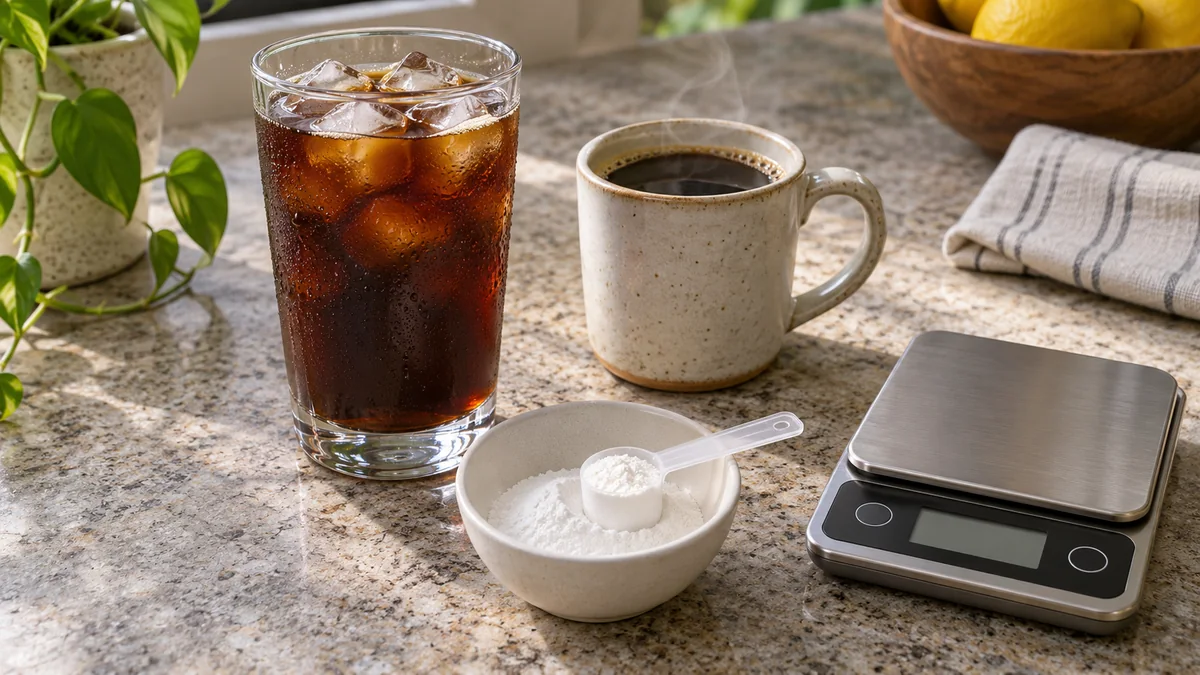
Can you put creatine in coffee? Yes. For adults who already choose to use creatine monohydrate, coffee can be a convenient way to take it. You can stir unflavored creatine into hot coffee or pre-dissolve it before pouring an iced coffee. The important questions are dose, texture, storage, caffeine tolerance and whether supplementation is appropriate for you—not whether the drink is a magical weight-loss or brain-health remedy.
Quick recipe: Brew a cup of coffee, let it come down from scalding-hot temperature, stir in a label-appropriate serving of unflavored creatine monohydrate (often 3–5 g in adult studies), and drink shortly after mixing. For an iced version, mix the powder into a little warm liquid first, then pour over ice.
This is a recipe-and-evidence guide to creatine coffee. If you’re specifically looking for why the scale changes after starting creatine, read creatine water weight explained.
What Is Creatine Coffee?
Creatine coffee is ordinary brewed coffee, espresso or cold brew with added creatine powder. Creatine is a compound involved in the phosphocreatine system, which helps supply energy during short, intense bouts of exercise. Creatine monohydrate is the most extensively researched supplement form. It has no coffee flavor of its own; the final taste depends primarily on the beans, milk and sweeteners.
A coffee drink does not become high in protein because it contains creatine. Creatine is not the same thing as dietary protein, and a “protein coffee” recipe has a different nutritional purpose. See protein coffee recipes and benefits for that separate cluster.
Can You Mix Creatine With Hot Coffee?
Creatine is relatively stable as a dry powder but slowly converts to creatinine after being dissolved in liquid; temperature, pH and time affect the rate. This does not establish that adding powder to a normal hot coffee instantly destroys it. For practical use, mix just before drinking instead of holding a prepared hot creatine coffee in a thermos for an entire day.
A published study examining creatine in beverage matrices including coffee found that thermal stress is an important variable, but it does not give a precise universal “safe coffee temperature” or a guarantee of zero change over 30 minutes. For readers who want the chemistry, see the 2025 multi-analytical study of creatine degradation and the critical review of creatine stability in solution.
Ingredients and Equipment for Creatine Coffee
- One serving of plain, unflavored creatine monohydrate, in accordance with its label or your clinician’s guidance
- 240–300 ml (8–10 fl oz) brewed coffee or americano or 60 ml double espresso for the iced recipe
- Water, ice and optional milk, depending on the version
- Optional cinnamon or vanilla; avoid unnecessarily high-caffeine add-ins
Use a calibrated gram scale if the product’s scoop size is uncertain. Do not substitute creatine hydrochloride (HCl), a flavored multi-ingredient pre-workout, or another supplement merely because the label says “creatine”: acid, flavorings, stimulants and dose can differ.
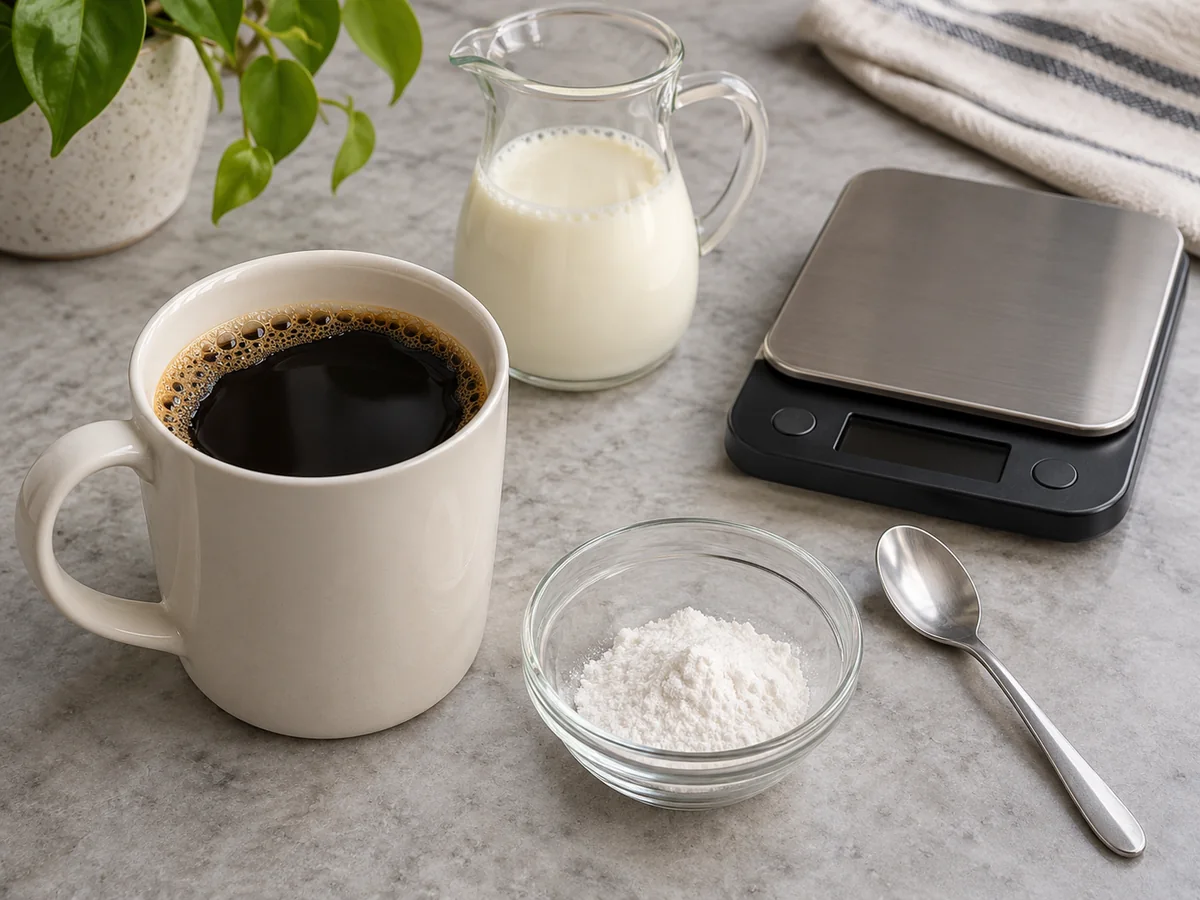
Recipe 1: Hot Creatine Coffee
Print
Hot Creatine Coffee
A simple hot brewed coffee stirred with a measured serving of plain creatine monohydrate.
- Total Time: 2 minutes
- Yield: 1 cup 1x
Ingredients
- 240–300 ml (8–10 fl oz) brewed coffee or americano
- 3 g plain unflavored creatine monohydrate, or the amount appropriate to the product label or clinician’s advice
- Optional cinnamon or vanilla to taste
Instructions
- Brew a cup of coffee or prepare an americano.
- Let the coffee cool briefly to a comfortable sipping temperature rather than drinking it scalding hot.
- Measure plain creatine monohydrate with a gram scale if the product scoop size is uncertain.
- Add the creatine to the coffee and stir or whisk thoroughly until well dispersed.
- Drink soon after mixing; stir again if a little powder settles.
Notes
This is a beverage recipe, not personalized supplementation advice. Follow your product label and seek medical advice if you have kidney disease, take relevant medications, are pregnant or have other medical concerns.
Creatine is not caffeine or a stimulant; coffee caffeine content varies widely with brewing method.
Avoid using multi-ingredient pre-workout products or creatine HCl as an automatic substitute for unflavored monohydrate.
Do not batch-prep the combined drink for days.
Black coffee has negligible food energy; supplement servings and caffeine content are brand- and preparation-dependent.
Coffee brewing time is additional.
- Prep Time: 2 minutes
- Cook Time: 0 minutes
- Category: Drinks
- Method: Stirring
- Cuisine: Contemporary
Keywords: creatine coffee, hot creatine coffee, creatine in coffee
Yield: 1 cup. Active time: 1–2 minutes, plus coffee brewing.
- Brew 240–300 ml (8–10 fl oz) coffee. For a milder taste, make an americano using espresso and hot water.
- Let the coffee cool briefly so it is comfortable to drink rather than scalding.
- Add a measured 3 g of plain creatine monohydrate (or the appropriate amount specified for you) and stir or whisk thoroughly until dispersed.
- Drink soon after mixing. If some powder settles, stir again rather than treating slight sediment as proof of spoilage.
Black coffee provides negligible energy, while the amount of caffeine varies considerably by bean and brewing method. A commonly cited reference for an 8 fl oz brewed coffee is about 95 mg caffeine, but a single café serving can be higher or lower. Creatine is not a stimulant.
Recipe 2: Iced Creatine Coffee Without Grit
Print
Iced Creatine Coffee
An iced creatine coffee that uses warm espresso and water to help disperse creatine before adding the chilled ingredients.
- Total Time: 3 minutes
- Yield: 1 tall iced coffee 1x
Ingredients
- 60 ml (2 fl oz) warm double espresso
- 60 ml (2 fl oz) warm water
- 3 g plain unflavored creatine monohydrate; up to 5 g only if appropriate to your product label or clinician’s advice
- 120 ml (1/2 cup) cold water or milk
- Ice to fill a tall serving glass
Instructions
- Prepare a double espresso and measure 60 ml warm water.
- Whisk the measured creatine thoroughly into the warm espresso and water to disperse it.
- Fill a tall serving glass with ice and add the 120 ml cold water or milk.
- Pour the espresso–creatine mixture over the ice and stir thoroughly.
- Serve immediately; stir again if a little sediment settles.
Notes
Cold creatine monohydrate has limited solubility. Warm mixing liquid can help, but the result is not guaranteed to be completely sediment-free.
If 5 g leaves powder behind, use a little more warm mixing liquid or a finer monohydrate formulation rather than promising “zero grit.”
Use unflavored monohydrate; other creatine products can differ in acidity, ingredients and dosage.
Follow individual health guidance and product labels for supplements.
Nutrition depends on whether the optional cold liquid is water, dairy milk or plant milk; do not insert fixed values.
Coffee preparation not included.
- Prep Time: 3 minutes
- Cook Time: 0 minutes
- Category: Drinks
- Method: Pre-dissolving and chilling
- Cuisine: Contemporary
Keywords: iced creatine coffee, creatine iced coffee, coffee with creatine
Yield: 1 tall iced coffee. Active time: about 2–3 minutes once the coffee is made.
- 60 ml (2 fl oz) warm double espresso
- 60 ml (2 fl oz) warm water
- 3–5 g plain creatine monohydrate, if appropriate to your plan
- 120 ml (½ cup) chilled water or milk
- Ice
- Whisk the creatine thoroughly into the warm espresso and 60 ml warm water before adding ice.
- Fill a tall glass with ice, then add 120 ml cold water or milk.
- Pour the mixed espresso over the ice and stir. Serve immediately.
Creatine monohydrate has limited solubility in cold liquids, so some sediment is possible even after pre-dissolving. Warm liquid helps dispersion, but a “zero-grit” outcome cannot be guaranteed for every powder, dose or cup size. If a more concentrated 5 g serving leaves powder behind, increase the warm mixing liquid slightly, try micronized monohydrate or divide the liquid before chilling.
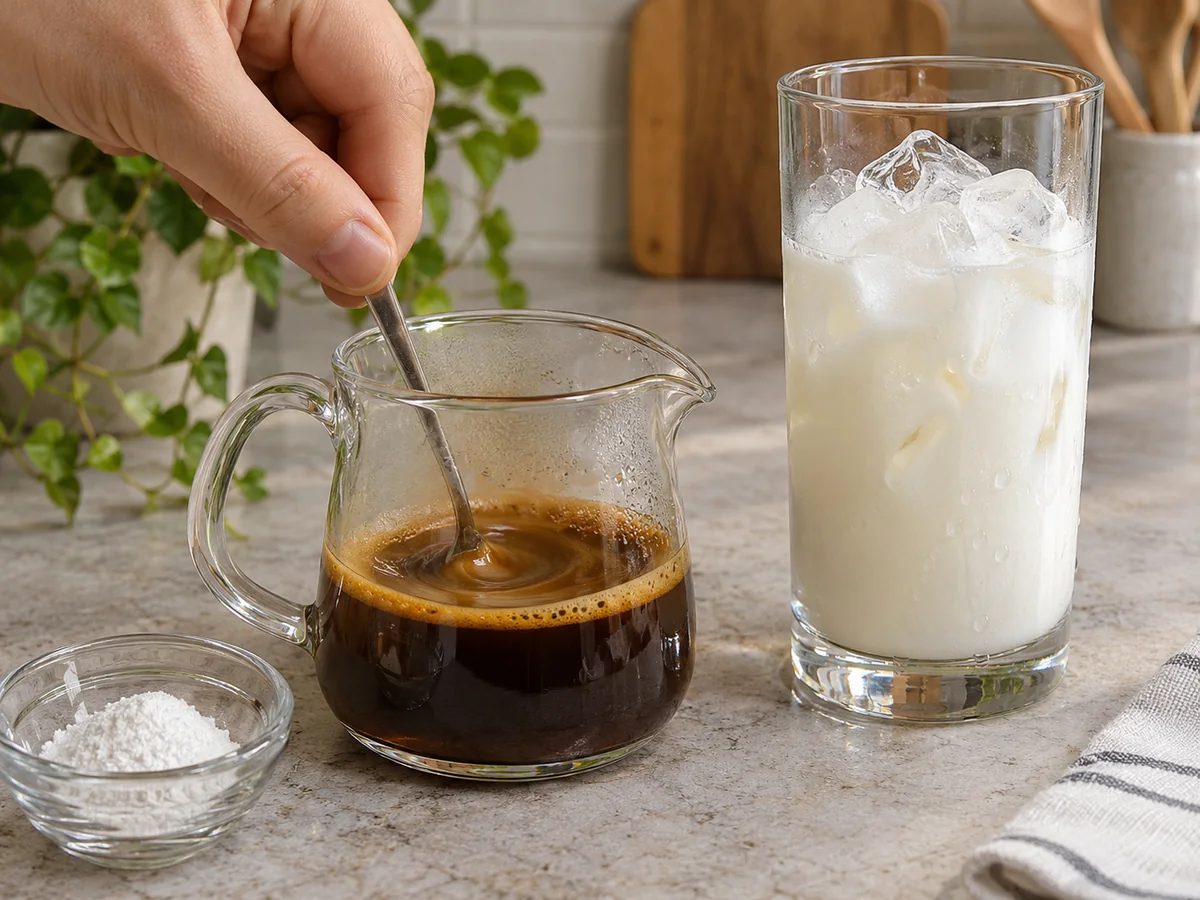
Recipe 3: Creatine Protein Latte
PrintCreatine Protein Latte
A creamy coffee drink combining a labeled protein powder serving with an appropriate amount of plain creatine monohydrate; serve warm or iced.
- Total Time: 3 minutes
- Yield: 1 substantial latte 1x
Ingredients
- 240 ml (1 cup) unsweetened almond milk or ultrafiltered dairy milk
- 1 scoop (about 30 g) vanilla whey isolate providing about 25 g protein, according to its label
- 3 g plain unflavored creatine monohydrate, or the amount appropriate to your plan
- 60 ml (2 fl oz) espresso, cooled for the iced version
- Optional ice
- Optional small pinch of cinnamon
Instructions
- Place milk and vanilla protein powder in a blender and mix briefly until smooth.
- Add the measured plain creatine monohydrate and mix again briefly; alternatively disperse it in a small amount of lukewarm water first.
- For an iced latte, fill a glass with ice, pour in the milk mixture and add cooled espresso.
- For a warm latte, gently warm the milk mixture without boiling it and stir in the espresso.
- Serve promptly after preparing.
Notes
Nutrition depends on the protein powder and milk label; ultrafiltered dairy milk is nutritionally different from unsweetened almond milk.
Collagen protein is not automatically equivalent to whey for amino-acid composition.
Avoid very hot blending in a sealed blender; follow appliance safety instructions.
The creatine amount is not a medical recommendation; follow product and clinician guidance where applicable.
Protein may be approximately 25 g from the powder alone if its label confirms that amount. Calculate full macros from actual milk and protein brands.
Allow time to cool espresso when making the iced version.
- Prep Time: 3 minutes
- Cook Time: 0 minutes
- Category: Drinks
- Method: Blending
- Cuisine: Contemporary
Keywords: creatine protein latte, protein coffee with creatine, iced creatine latte
Yield: 1 substantial latte. Active time: about 3 minutes.
- 240 ml (1 cup) unsweetened almond milk or ultrafiltered dairy milk
- One 30 g scoop vanilla whey isolate supplying approximately 25 g protein, or an appropriately labeled alternative
- 3–5 g plain creatine monohydrate, if appropriate
- 60 ml (2 fl oz) espresso, cooled if making iced
- Ice and a small pinch of cinnamon, optional
- Blend the milk and protein powder briefly until no visible clumps remain.
- Add the measured creatine and blend briefly again, or mix it first into a little lukewarm water.
- For an iced latte, pour into an ice-filled glass and add the cooled espresso. For a warm latte, heat the milk mixture gently rather than boiling it, and stir in the espresso.
- Serve soon after preparation. Do not keep a mixed latte at room temperature for later use.
A latte made with unsweetened almond milk and a protein isolate labeled as providing 25 g protein per serving may contain roughly 145 kcal and 26 g protein. These are brand-dependent estimates, not fixed nutrition values. Ultrafiltered dairy milk could add substantial extra protein and calories. Do not use a collagen powder as a nutritionally equivalent replacement for whey without accounting for differences in amino-acid profile.
Creatine Monohydrate vs Creatine HCl in Coffee
| Feature | Monohydrate | HCl |
|---|---|---|
| Research base | Most studied form for sport performance | More limited comparative evidence |
| Mixing | May settle, especially in iced coffee | Often mixes readily but can be acidic |
| Milk latte | Usually the simpler default ingredient | Acidic formulations may affect milk stability |
| Typical evidence-based adult daily maintenance amount | Often 3–5 g in sports-nutrition studies | Do not assume the same scoop or equivalence |
Milk separation can also arise from acidic espresso, the protein powder or a plant-milk formulation. It is not possible to diagnose every curdled latte as “creatine HCl” from appearance alone.
Does Caffeine Cancel Creatine Benefits?
There is no good basis for the blanket claim that caffeine always cancels creatine. The interaction is complex: some studies of prolonged high caffeine use during creatine loading have reported less benefit under particular protocols; others have not, and studies of acute caffeine after creatine saturation can show performance benefits. The outcomes depend on dose, timing, training and participant population.
For an accurate overview, see the systematic review on concurrent creatine and caffeine and the NIH sports-supplement review. These publications do not prove that adding creatine to a cup of coffee delivers extra cognitive, weight-loss or hormone benefits.
How Much Creatine Should You Add?
Research on creatine monohydrate for adults often studies 3–5 g per day for maintenance after or without a loading phase. That range does not mean every reader needs supplementation, and taking more is not automatically better. Follow your product label and the advice of your healthcare professional, particularly if you have kidney disease, are pregnant, are breastfeeding, take relevant medications, or are supervising a minor. Higher single doses can increase gastrointestinal discomfort.
For people taking GLP-1 medication, the presence of creatine in a coffee does not replace adequate total nutrition, strength training or individualized medical guidance. If the concern is getting enough protein in a tolerable small serving, our GLP-1 protein shake recipe covers that separate food-first question.
Does Creatine Coffee Cause Weight Gain or Bloating?
Creatine supplementation can be associated with changes in body water, especially when starting or using a loading protocol. Those changes should not be confused with a precise number of pounds of fat gained or lost. See our detailed creatine water-weight guide for the distinction between body-water changes, daily scale fluctuations and muscle adaptation.
Food Safety, Caffeine and Who Should Be Cautious
Use fresh coffee and properly handled milk. Refrigerate perishable ingredients and serve the finished latte promptly. A prepared creatine coffee is not a tested shelf-stable supplement beverage; make it when you intend to drink it. Caffeine can worsen anxiety, palpitations, sleep or reflux in sensitive people. People who are pregnant often receive guidance to remain below 200 mg caffeine daily from all sources; see ACOG pregnancy caffeine guidance. This is not a recommendation to use creatine during pregnancy.
If you prefer a coffee drink built around dietary protein rather than supplementation, visit protein coffee benefits and recipes.
For a cinnamon-forward drink centered on dietary protein without added creatine, see our protein horchata recipe, including a rice-based and a two-minute version.

FAQS
Can I mix creatine with coffee every day?
Some adults use creatine daily as part of a supplement routine. Whether that is appropriate for you depends on your health, goals and product instructions; coffee is simply one mixing option.
Does hot coffee instantly destroy creatine?
No, there is no evidence that normal short mixing instantly destroys the full dose. Stability depends on temperature, acidity and time, so mixing shortly before drinking is sensible.
Why is my iced creatine coffee gritty?
Creatine monohydrate dissolves less readily in cold liquid. Mix first into a little warmer liquid, then add ice.
Can I add creatine to a latte with milk?
Usually plain monohydrate can be mixed into a milk latte. Avoid assuming acidic flavored blends behave the same way and follow the product instructions.
Is creatine coffee the same as protein coffee?
No. Creatine is not a protein powder. A creatine coffee may contain virtually no protein unless milk or a protein ingredient is added.
Does coffee reduce the effect of creatine?
Research is mixed for some high-dose or loading protocols; ordinary co-ingestion has not been shown to universally negate the benefits of creatine.
Can creatine coffee help with weight loss?
There is no established clinical evidence that this combination causes fat loss. The drink should not be marketed as a weight-loss treatment.
How long can I store premixed creatine coffee?
Prepare it fresh and drink soon after mixing; do not store a hot acidic coffee with creatine in a thermos all day or treat a milk latte as shelf-stable.