
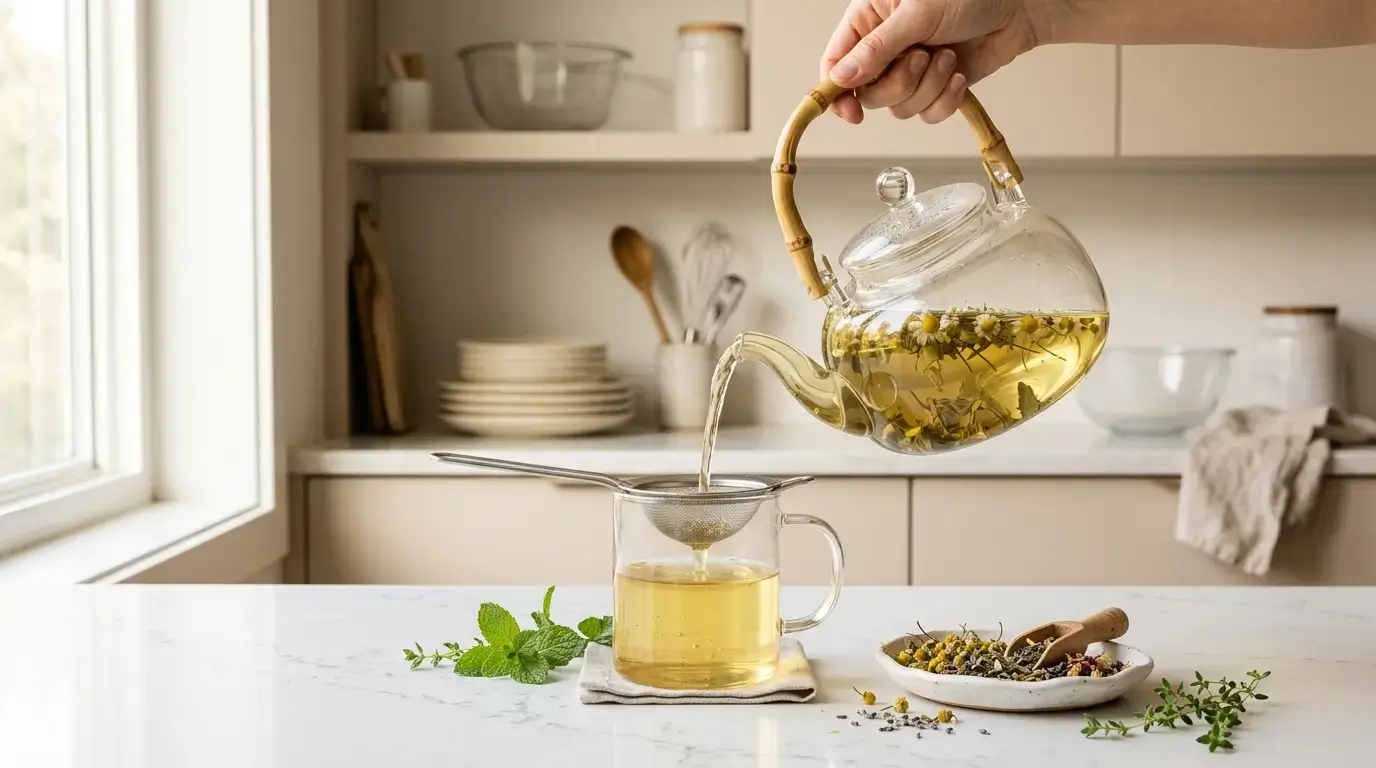
How to make herbal tea comes down to three decisions: temperature, steeping time, and straining. Get those right and the rest — bags vs loose leaf, fresh vs dried, hot vs cold — is a matter of preference and convenience. Get them wrong and even the highest-quality chamomile or hibiscus will produce a flat, bitter, or medicinal-tasting cup. This guide covers every method — tea bags, loose leaf, fresh herbs, roots and barks, and cold brew — with the specific temperatures and times that produce the best result from each.
What Is Herbal Tea?
Herbal tea (also called a tisane or herbal infusion) is any beverage made by steeping plant material — flowers, leaves, roots, bark, seeds, or fruit — in hot or cold water. Unlike green tea, black tea, or oolong, herbal teas are not made from Camellia sinensis and are naturally caffeine-free.
The category is vast: chamomile, peppermint, hibiscus, ginger, lemon balm, rooibos, dandelion, nettle, mullein, spearmint, red clover, raspberry leaf — each is brewed differently. This guide gives you the universal principles that apply to all of them, plus the specific adjustments for different herb types.
For a complete guide to the health benefits of specific herbal teas, see our herbal teas guide.
The Most Important Variable: Temperature
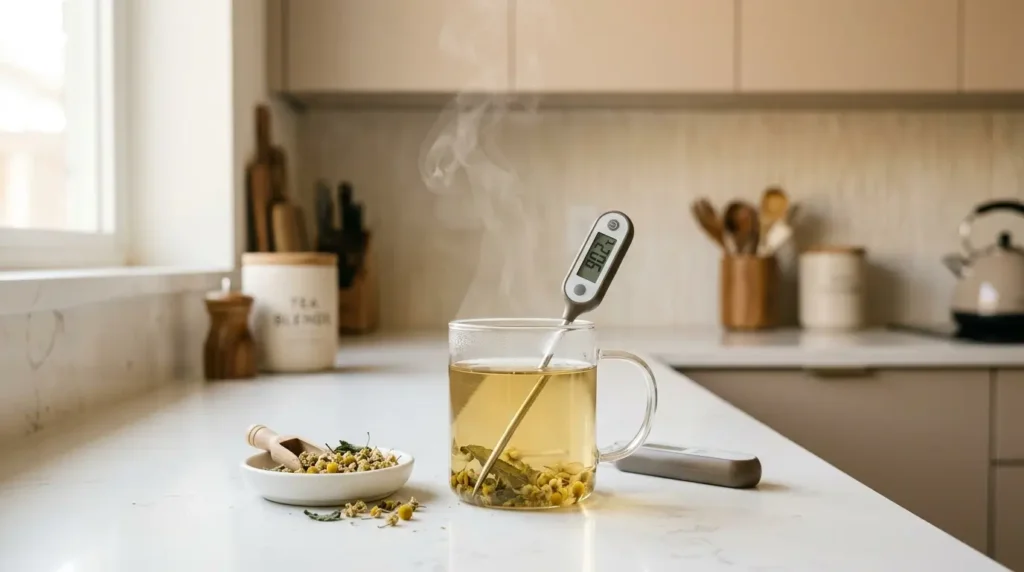
Water temperature affects two things simultaneously: how much of the beneficial compounds are extracted, and how much bitterness is produced. Most people use water that is too hot, which produces an unnecessarily harsh cup.
Herbal tea temperature guide by herb type:
| Herb type | Temperature | Examples |
|---|---|---|
| Delicate flowers and leaves | 85–90°C (185–195°F) | Chamomile, lemon balm, lavender, rose |
| Standard leaves and flowers | 90–95°C (195–205°F) | Peppermint, hibiscus, spearmint, nettle |
| Roots and bark | 95–100°C / simmer | Ginger, burdock root, licorice root, dandelion root |
| Seeds | 90–95°C (195–205°F) | Fennel seeds, cardamom |
| Berries and fruit | 90–95°C (195–205°F) | Rosehip, elderberry |
The practical rule: Let boiling water cool for 2–3 minutes before pouring over delicate herbs. For roots and bark, maintain a gentle simmer rather than a full rolling boil.
For hibiscus tea specifically — one of the most temperature-sensitive herbal teas — our dedicated guide on hibiscus tea hot or cold covers exactly how temperature affects both flavor and health benefits.
Steeping Times by Herb Type
Steeping time is the other critical variable. Under-steeping produces a weak, flavorless cup. Over-steeping produces bitterness and can make the tea medicinal rather than pleasant.
| Herb type | Steeping time | Notes |
|---|---|---|
| Delicate flowers | 3–5 minutes | Chamomile, rose — longer increases bitterness |
| Standard leaves | 5–7 minutes | Peppermint, spearmint, lemon balm |
| Hibiscus calyces | 5–10 minutes | Longer = more tart and acidic |
| Roots (steeped) | 10–15 minutes | Dandelion root, burdock |
| Roots (simmered) | 5–10 minutes simmering | Ginger, licorice root — simmer extracts more |
| Nettle | 10–15 minutes | Longer steep = more minerals |
| Mullein | 10–15 minutes | Always strain through fine mesh |
| Rooibos | 5–7 minutes | Very forgiving — hard to over-steep |
Always cover the cup while steeping. This is the most commonly skipped step in home herbal tea preparation. The aromatic volatile oils that give herbs like peppermint, lemon balm, and chamomile their distinctive character escape as steam from an uncovered cup. Covering preserves both flavor and active compounds.
Method 1: Tea Bags
The most convenient method — suitable for daily use when active compound extraction precision is less critical.
Step by step:
- Place 1 tea bag in your cup
- Pour water at the right temperature for your herb (see guide above)
- Cover the cup with a small plate or saucer
- Steep for the recommended time — check the packaging but use the guide above as a reference
- Remove the tea bag by the string — do not squeeze the bag, which releases bitter tannins into the tea
- Add honey or lemon if desired
Quality tip: Commercial herbal tea bags vary significantly in quality. Look for bags with whole or cut dried herbs rather than fine powder — fine powder extracts faster but also extracts more bitter compounds. If you can see the herb material through the bag, it is generally a better product.
Method 2: Loose Leaf Herbal Tea
Loose leaf produces a more flavorful, more complex cup than tea bags because it uses larger pieces of the herb with more surface area variety. It also allows you to adjust the amount precisely.
Equipment you need:
- A tea infuser ball, basket infuser, or strainer
- Or a teapot with a built-in filter
- Or a French press
Step by step:
- Measure 1–2 teaspoons of dried herbs per 240ml cup
- Place in your infuser or directly in a teapot
- Pour hot water at the correct temperature
- Cover and steep for the recommended time
- Strain thoroughly — herbal tea particles can be fine, especially with herbs like mullein or hibiscus
- Serve immediately
Ratio guidance:
- 1 tsp per 240ml = mild, gentle cup
- 2 tsp per 240ml = standard strength
- 3 tsp per 240ml = strong, medicinal strength
For medicinal-use teas (mullein for respiratory support, nettle for iron), use 2 teaspoons per cup and steep toward the longer end of the time range.
Method 3: Fresh Herbs
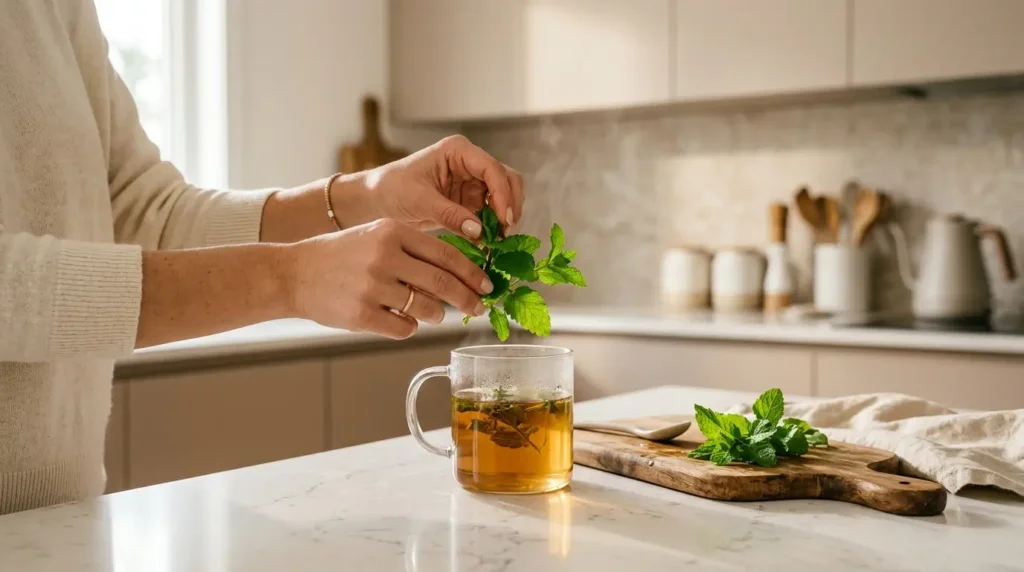
Fresh herbs produce a brighter, more vibrant, more intensely aromatic cup than dried herbs. The volatile oils are fully intact rather than partially diminished by the drying process.
The key adjustment: Fresh herbs contain much more water than dried, so you need 3 times the amount compared to dried.
| Herb | Dried amount | Fresh equivalent |
|---|---|---|
| Peppermint | 1 tsp | 1 tablespoon (about 10 leaves) |
| Lemon balm | 1 tsp | 1 tablespoon fresh leaves |
| Chamomile | 1 tsp | 2 tablespoons fresh flowers |
| Ginger | 1 tsp dried | 3–5 thin slices fresh root |
| Mint (any) | 1 tsp | 8–10 fresh leaves |
Step by step:
- Gently bruise or tear fresh leaves before steeping — this releases more of the volatile oils
- Place in your cup or teapot
- Pour hot water at the appropriate temperature
- Cover and steep for the same time as you would with dried herbs
- Strain well — fresh herbs can leave small particles
Fresh peppermint, lemon balm, chamomile (flowers only), and ginger are the most accessible fresh herb teas for home gardens or fresh produce sections. For the full benefits of lemon balm specifically, our lemon balm tea benefits guide covers why covering the cup is especially important for this herb.
Method 4: Roots and Bark (Decoction Method)
Roots, bark, and hard seeds require a different approach from leaves and flowers. Simple steeping does not break down the cell walls sufficiently to extract the active compounds — you need to simmer them.
The decoction method:
- Add your root or bark to cold water in a small saucepan (1 tablespoon per 300ml for roots)
- Bring to a gentle simmer
- Simmer — not boil — for 5–15 minutes depending on density
- Remove from heat and steep for an additional 5 minutes off the heat
- Strain through a fine mesh strainer
- Add honey to balance the often-earthy flavor
Herbs that need decoction:
- Fresh or dried ginger root (simmer 5–10 minutes)
- Dandelion root (simmer 10 minutes)
- Burdock root (simmer 10 minutes)
- Licorice root (simmer 5–10 minutes)
- Cinnamon sticks (simmer 10–15 minutes)
For ginger specifically — where simmering dramatically increases the active gingerol extraction compared to steeping — our ginger tea benefits guide explains why decoction matters for this herb’s medicinal properties.
Method 5: Cold Brew Herbal Tea
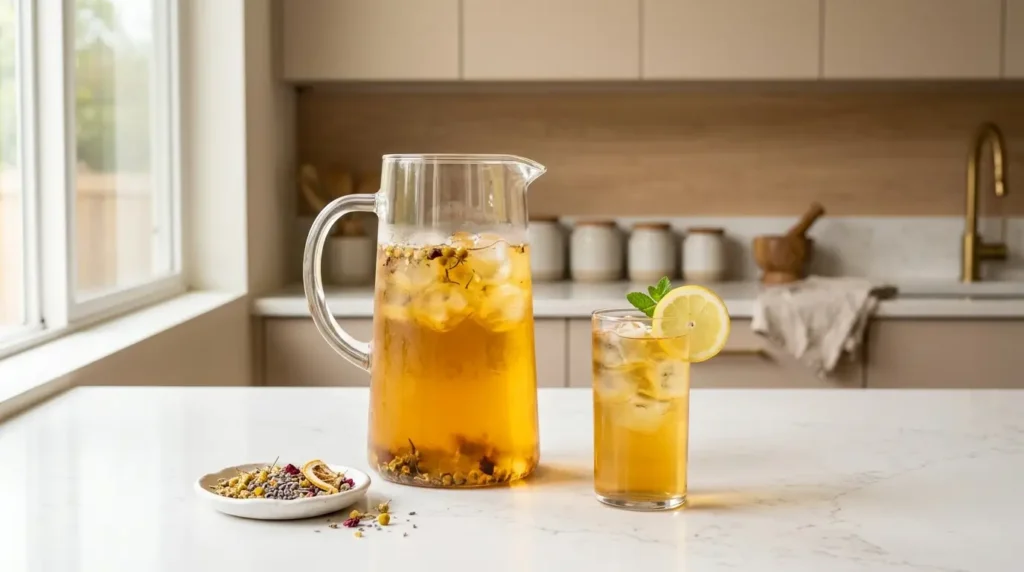
Cold brewing is an underused method that produces an exceptionally smooth, naturally sweet, non-bitter cup — often with different active compound profiles than hot brewing.
How it works: Cold water extracts compounds more slowly and selectively than hot water. It extracts fewer tannins (which cause bitterness and astringency) and more of the gentle aromatic compounds. The result is often sweeter and more approachable than the equivalent hot brew.
Cold brew method:
- Add 1 tablespoon of dried herbs per 500ml of cold filtered water in a glass pitcher
- Cover the pitcher
- Refrigerate for 8–12 hours (overnight is most practical)
- Strain thoroughly through a fine mesh strainer
- Keep refrigerated and consume within 4–5 days
Best herbs for cold brew:
- Hibiscus (produces a beautiful ruby red, smooth and less acidic than hot brew)
- Peppermint (intensely fresh, very smooth)
- Chamomile (gentle and naturally sweet)
- Rooibos (earthy and smooth)
- Lemon balm (bright and lemony)
For an extensive collection of cold brew herbal tea recipes and combinations, see our cold brew herbal tea recipes guide. For the specific comparison of hot vs cold brew hibiscus tea and how it affects both flavor and health benefits, see our hibiscus tea hot or cold guide.
The Straining Step — Why It Matters
Proper straining is the most neglected step in herbal tea preparation. Leaving herb particles in the cup continues to extract compounds — often bitter ones — even after you have reached the optimal steeping time.
Straining guidelines by herb:
- Chamomile, lavender, rose: regular fine mesh strainer — fine but manageable particles
- Peppermint, spearmint, lemon balm: regular fine mesh strainer
- Hibiscus: fine mesh essential — the calyx particles are very fine and numerous
- Mullein: very fine mesh or coffee filter essential — the leaf hairs can irritate the throat if consumed
- Roots and bark: regular fine mesh strainer after simmering
For making hibiscus tea with perfect straining, our how to make hibiscus tea guide covers the complete process in detail.
Herbal Tea Ratios — Complete Quick Reference
| Method | Herb amount | Water | Time | Temperature |
|---|---|---|---|---|
| Tea bag | 1 bag | 240ml | Per packaging | 90–95°C |
| Loose leaf (mild) | 1 tsp | 240ml | 5–7 min | 90–95°C |
| Loose leaf (standard) | 2 tsp | 240ml | 5–10 min | 90–95°C |
| Fresh herbs | 1 tbsp | 240ml | 5–10 min | 90–95°C |
| Root/bark (decoction) | 1 tbsp | 300ml | Simmer 5–10 min | 95–100°C |
| Cold brew | 1 tbsp | 500ml | 8–12 hours | Cold water |
| Large batch cold brew | 3 tbsp | 1 liter | 8–12 hours | Cold water |
Common Mistakes When Making Herbal Tea
Using boiling water for delicate herbs: 100°C water destroys volatile oils in chamomile, lemon balm, and lavender. Let it cool for 2–3 minutes after boiling.
Not covering the cup while steeping: The most universal and most commonly skipped step. Always cover.
Over-steeping: Past the recommended time, most herbs produce bitterness rather than more flavor. Set a timer.
Under-straining: Leaving particles in the cup continues extraction. Strain thoroughly and immediately.
Squeezing the tea bag: Releases concentrated bitter compounds from the bag. Lift and remove without squeezing.
Using the wrong amount: 1 teaspoon per 240ml is a starting point — adjust up for more flavor, down for milder taste.
Herbal Tea vs Green Tea: Is There a Difference in How to Make Them?
Yes — significantly. Green tea (Camellia sinensis) is much more temperature-sensitive than most herbal teas: 70–80°C is ideal, and boiling water will destroy the catechins (EGCG) and produce a bitter, astringent cup. Most herbal teas tolerate 90–95°C without significant compound degradation. For the full comparison of herbal and green tea benefits and preparation, see our herbal tea vs green tea benefits guide.
Frequently Asked Questions
How do you make herbal tea?
Add 1–2 teaspoons of dried herbs (or 1 tablespoon fresh) to your cup, pour hot water at 90–95°C over them, cover the cup, steep for 5–10 minutes depending on the herb, and strain thoroughly. Cover while steeping to preserve aromatic volatile compounds.
What temperature should herbal tea be brewed at?
Most herbal teas: 90–95°C (195–205°F). Delicate flowers like chamomile: 85–90°C (185–195°F). Roots and bark: gentle simmer at 95–100°C. The temperature guide in this article covers all common herb types.
How long should you steep herbal tea?
Delicate flowers: 3–5 minutes. Standard leaves and flowers: 5–7 minutes. Hibiscus: 5–10 minutes. Roots: 10–15 minutes steeped, or 5–10 minutes simmered. Always cover while steeping and strain promptly when done.
How much herbal tea should I put in a cup?
1 teaspoon of dried herbs per 240ml for mild flavor; 2 teaspoons for standard strength; 3 teaspoons for medicinal strength. For fresh herbs, use 3x the dried amount (approximately 1 tablespoon per cup).
Can I make herbal tea with fresh herbs?
Yes — use approximately 3 times the amount you would use dried (about 1 tablespoon fresh per cup). Gently bruise or tear the leaves before steeping to release more volatile oils. Fresh herbs produce a brighter, more aromatic cup than dried.
How do you cold brew herbal tea?
Add 1 tablespoon of dried herbs per 500ml of cold water to a glass pitcher. Cover and refrigerate for 8–12 hours. Strain and serve. Cold brew produces a naturally smoother, less bitter cup than hot brew for most herbal teas.
Why does my herbal tea taste bitter?
Usually from over-steeping or water that is too hot for delicate herbs. Try reducing steeping time by 2 minutes or letting boiling water cool slightly before pouring. Also ensure you are straining immediately after steeping rather than leaving herbs in the cup.
Does herbal tea have caffeine?
No — true herbal teas (tisanes) made from plants other than Camellia sinensis are naturally caffeine-free. Only teas made from the Camellia sinensis plant (black, green, white, oolong, matcha) contain caffeine.
Key Takeaways
- The three critical variables are temperature, steeping time, and thorough straining — everything else is secondary
- Always cover the cup while steeping — volatile oils escape as steam from an uncovered cup
- Most herbal teas: 90–95°C, 5–10 minutes; delicate flowers: 85–90°C, 3–5 minutes; roots: simmer 5–10 minutes
- Use 1–2 teaspoons dried herbs per 240ml; for fresh herbs use 3x the amount (1 tablespoon)
- Cold brew (8–12 hours in the refrigerator) produces a smoother, less bitter result for most herbal teas
- Never squeeze the tea bag — it releases concentrated bitter compounds
- Herbal teas are naturally caffeine-free — none of them come from the Camellia sinensis plant
- Strain immediately after steeping — leaving herbs in the cup continues extracting bitter compounds