

Mullein tea benefits are most distinctive in a single area that most herbal teas cannot claim: respiratory health. Made from the leaves and flowers of Verbascum thapsus — the common mullein plant — this caffeine-free herbal tea has been used by ancient Greeks, Native Americans, and European herbalists for thousands of years specifically to treat coughs, bronchitis, asthma, and respiratory congestion. Its mechanisms are well understood pharmacologically, and its safety profile is exceptionally clean. This guide covers what mullein tea actually does, what the research supports, the important preparation step most people skip, and how it compares to other respiratory herbal teas.
What Is Mullein Tea?
Mullein tea is brewed from the dried leaves and sometimes flowers of Verbascum thapsus — a tall biennial plant with large, soft, velvety silvery-green leaves and a tall spike of small yellow flowers. It grows abundantly across Europe, Asia, North Africa, and North America in meadows, roadsides, and disturbed soils.
The plant has been used in herbal medicine for over 2,000 years. Ancient Greeks used it for respiratory complaints. Native American tribes used mullein smoke and tea for lung conditions. European folk medicine has consistently used it as a primary remedy for coughs and bronchitis.
Does mullein tea have caffeine? No — mullein tea is completely caffeine-free and can be consumed at any time of day, including before bed.
What does mullein tea taste like? Mild, earthy, and slightly sweet — less bitter than dandelion or milk thistle tea. Most people find it pleasant and easy to drink, especially with a small amount of honey.
The Active Compounds in Mullein
Mullein’s therapeutic properties come from a distinctive set of plant compounds:
Saponins — the primary expectorant agents. Saponins are naturally foaming compounds that thin bronchial secretions (mucus), making it easier to cough up and clear from the airways. This is mullein’s core respiratory mechanism.
Mucilage — approximately 3% of mullein’s leaf composition. Mucilage is a sticky, gel-like substance that coats mucous membranes on contact, creating a protective anti-inflammatory film over irritated throat and bronchial tissue. This is the demulcent effect — the mechanism behind the soothing sensation mullein tea produces in the throat.
Flavonoids (quercetin, luteolin, kaempferol) — potent anti-inflammatory compounds that reduce airway inflammation and have demonstrated activity against NF-kB — a key regulator of inflammatory gene expression.
Iridoid glycosides — compounds with documented anti-inflammatory, antiviral, and neuroprotective properties.
Phenylethanoid glycosides and verbacosides — antimicrobial and antioxidant compounds specific to the Verbascum genus.
The combination of expectorant saponins and soothing mucilage is what makes mullein uniquely effective for respiratory conditions compared to most other herbal teas.
Mullein Tea Benefits: What the Research Shows
1. Respiratory Health — The Primary Benefit
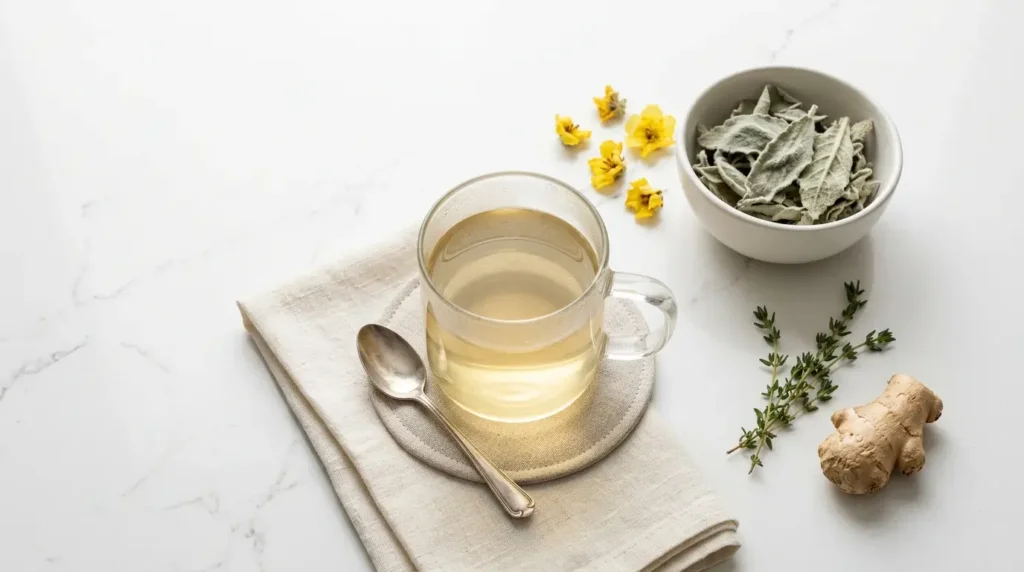
This is mullein’s most documented and traditionally consistent benefit. Its two mechanisms — expectorant and demulcent — work together to address respiratory symptoms from different angles simultaneously.
As an expectorant: Mullein’s saponins stimulate the production of more watery mucus and help break down thick, sticky secretions in the bronchial tubes. This makes coughs more productive — moving mucus out of the airways rather than trapping it in place. According to pulmonologists, clearing mucus from the airways is medically important because thick mucus plugs can block airflow and, in severe cases, contribute to lung collapse.
As a demulcent: The mucilage in mullein coats the mucous membranes of the throat and bronchial passages, reducing the friction and irritation that triggers dry, unproductive coughs. This is why mullein tea produces a notably soothing sensation in the throat within minutes of drinking.
Conditions where mullein tea is traditionally used and pharmacologically supported:
- Productive and dry coughs
- Bronchitis (both acute and chronic)
- Asthma — reducing bronchial inflammation and loosening mucus
- Colds and flu — easing congestion and sore throat
- Hoarseness and laryngitis
- Mild upper respiratory infections
Honest assessment of the evidence: Most research on mullein is in vitro (cell studies) or animal-based — not large human clinical trials. The pharmacological mechanisms are well-understood and support the traditional uses, but definitive clinical trials in humans are still limited. What is consistent across 2,000 years of use across independent cultures and supported by the pharmacological profile is that mullein reliably soothes respiratory symptoms — even if rigorous double-blind trials are lacking.
2. Antimicrobial Activity
Multiple laboratory studies have found mullein extract effective against a range of bacteria and viruses:
Bacteria: Studies have found antimicrobial activity against Bacillus cereus, Staphylococcus aureus, E. coli, and bacteria associated with respiratory infections. A 2021 review confirmed the plant’s fluid extract is effective against bacteria that cause upper respiratory tract infections.
Viruses: Alcoholic extracts of mullein have shown antiviral activity in laboratory settings, including against certain viral strains relevant to respiratory infections.
Important caveat: These studies used extracts that are more concentrated than brewed tea. The antimicrobial compounds (saponins, flavonoids, phenylethanoids) are present in tea but at lower concentration. The antimicrobial effect of mullein tea is real but supportive — not a replacement for antibiotics in serious bacterial infections.
3. Anti-Inflammatory Effects
Mullein’s flavonoids — particularly quercetin, luteolin, and kaempferol — are potent anti-inflammatory compounds that reduce the production of pro-inflammatory cytokines including TNF-alpha and IL-2.
A 2024 rat-based study found that kaempferol (a key mullein flavonoid) helped stop cartilage damage and reduce joint pain — suggesting anti-inflammatory activity beyond the respiratory system that extends to joint and connective tissue health.
The anti-inflammatory effect on bronchial tissue is what makes mullein relevant for asthma management — reducing the chronic airway inflammation that makes airways hypersensitive and reactive.
4. Digestive Support
Traditional European herbalism used mullein tea for digestive complaints including diarrhea, intestinal cramps, and gastritis. The antispasmodic properties of mullein’s compounds relax smooth muscle in the gut, similar to the mechanism seen in chamomile and ginger.
Laboratory studies have confirmed antimicrobial activity against gut pathogens including E. coli and Staphylococcus aureus — bacteria that commonly cause intestinal infections. At tea concentration, this is a supportive benefit rather than a therapeutic intervention.
5. Diuretic Effect
Mullein has mild diuretic properties that increase urinary output and reduce fluid retention. This is a secondary benefit — less specific and less documented than the respiratory effects — but consistent with the plant’s general anti-inflammatory and kidney-flushing properties seen across many herbal teas.
6. Sleep Support
Mullein tea does not produce sedation in the way chamomile does. However, its ability to relieve respiratory discomfort — reduced coughing, soothed throat, loosened congestion — often allows people with respiratory symptoms to sleep more comfortably. The relief of discomfort enabling sleep is distinct from a direct sedative effect, but the practical outcome (better sleep) is the same for people whose sleep is disrupted by respiratory symptoms. For a full guide to sleep-supporting drinks, see our article on the best drinks for better sleep.
How to Make Mullein Tea — The Critical Preparation Step

Making mullein tea requires one preparation step that is not necessary for most other herbal teas: very fine straining.
Mullein leaves are covered in tiny, fine hairs — the same soft, velvety texture that makes the leaves feel like velvet. These hairs, if they pass into the brewed tea and are swallowed, can irritate the throat and mucous membranes — the opposite of what you want. Always strain mullein tea through a very fine mesh strainer or a coffee filter.
Standard hot brew:
- Add 1–2 teaspoons of dried mullein leaves to a cup or teapot
- Pour near-boiling water (90°C / 195°F) over the leaves
- Cover while steeping — covers the cup to prevent volatile compounds from escaping
- Steep for 10–15 minutes — longer than most herbal teas to maximize mucilage extraction
- Strain through a very fine mesh strainer or coffee filter — this step is essential
- Add raw honey to taste — honey adds its own antimicrobial and soothing properties that complement mullein perfectly
- Drink warm — the warmth enhances the soothing effect on the throat and airways
Mullein and ginger combination: Add 2–3 thin slices of fresh ginger during steeping. Ginger’s anti-inflammatory and antiemetic properties complement mullein’s respiratory effects. This is one of the most effective natural respiratory teas available. Our ginger tea benefits guide covers why ginger works so well for respiratory and digestive health.
Mullein flower tea: The flowers can be used instead of or in addition to the leaves. Mullein flower tea has a slightly lighter, more delicate flavor and contains high concentrations of iridoid glycosides — the antiviral and anti-inflammatory compounds. Steep 1 tablespoon of dried flowers per cup for 10 minutes.
How often: For acute respiratory symptoms, 2–3 cups per day until symptoms resolve. For general wellness, 1 cup per day.
For more cold herbal tea ideas, our cold brew herbal tea recipes guide covers herbal combinations that work well cold.
Print
Mullein Tea Benefits: What It Does for Your Lungs and Respiratory Health
Mullein tea is one of the most effective herbal teas for respiratory health. This simple recipe shows how to brew it correctly — including the critical straining step that most people skip — for a soothing, mucus-clearing cup every time.
- Total Time: 17 minutes
- Yield: 1 cup (240ml) 1x
Ingredients
- 1–2 tsp dried mullein leaves per 240ml water
- 1 tbsp dried mullein flowers (optional, can replace leaves)
- 2–3 slices fresh ginger (optional — for respiratory blend)
- Raw honey to taste
- Near-boiling water (90°C / 195°F)
Instructions
- Add dried mullein leaves to a cup or teapot
- Pour near-boiling water (90°C) over the leaves
- Cover the cup while steeping to preserve volatile compounds
- Steep for 10–15 minutes
- Strain through a very fine mesh strainer or coffee filter — this step is essential to remove the tiny leaf hairs that can irritate the throat
- Add raw honey to taste
- Drink warm — 2–3 cups daily for acute respiratory symptoms, 1 cup daily for wellness
Notes
The fine straining step is non-negotiable — mullein leaf hairs cause throat irritation if not removed. A coffee filter works best if your strainer is not fine enough. For a stronger respiratory blend, add 2–3 slices of fresh ginger during steeping. Mullein flower tea is slightly lighter in flavor and can be used as a substitute or addition. Store dried mullein in an airtight container away from light.
- Prep Time: 2 minutes
- Cook Time: 15 minutes
- Category: Drinks
- Method: Steeping
- Cuisine: Universal
- Diet: Vegan
Nutrition
- Serving Size: 1 cup (240ml)
- Calories: 2
- Sugar: 0g
- Sodium: 1mg
- Fat: 0g
- Saturated Fat: 0g
- Unsaturated Fat: 0g
- Trans Fat: 0g
- Carbohydrates: 1g
- Fiber: 0g
- Protein: 0g
- Cholesterol: 0mg
Keywords: how to make mullein tea, mullein tea recipe, mullein leaf tea, mullein tea for cough, respiratory herbal tea
Mullein Tea for Specific Respiratory Conditions

Cough (dry or productive): Mullein addresses both types. For productive coughs, the saponins thin mucus and help clear it. For dry, irritating coughs, the mucilage coats the throat and reduces the inflammation that triggers the cough reflex. Drink 1 cup warm with honey every 4–6 hours during acute symptoms.
Bronchitis: Mullein’s combination of expectorant and anti-inflammatory action is particularly well-suited to bronchitis — the combination of mucus production, airway inflammation, and persistent cough. 2–3 cups daily during the acute phase, combined with steam inhalation of mullein tea, may provide additional benefit.
Asthma: Mullein is used as a complementary support for asthma management — not a replacement for prescribed medication. Its anti-inflammatory flavonoids may reduce chronic airway inflammation, and its expectorant properties help clear the mucus that accumulates during asthmatic episodes. Never stop asthma medication in favor of any herbal remedy.
Sore throat and laryngitis: The demulcent mucilage effect is most immediately helpful for sore throats — the coating effect provides relief within minutes of drinking. Gargling with warm mullein tea before swallowing provides additional direct contact with the inflamed throat tissue.
Mullein Tea Side Effects and Safety
Mullein tea has one of the cleanest safety profiles of any herbal tea — there are no reports of major side effects or significant drug interactions at normal consumption levels.
The primary safety consideration: The leaf hairs. If not properly strained, the fine hairs from mullein leaves can cause throat irritation — always use a fine mesh strainer or coffee filter.
Allergies: Mullein is in the Scrophulariaceae family (not Asteraceae). People with ragweed or daisy allergies do not automatically react to mullein. However, some people are sensitive to the plant on skin contact. Start with a small amount if you have multiple plant sensitivities.
Pregnancy and breastfeeding: Little safety data exists. As a precaution, limit to 1 cup per day and consult your midwife before making it a daily habit.
Drug interactions: No significant drug interactions are currently documented for mullein tea at normal consumption levels — a significant advantage over milk thistle and some other herbal teas.
Excessive use: Prolonged or very high consumption has been associated with breathing problems and skin irritation in some reports. One to three cups per day is the recommended range.
For general herbal tea safety principles, our guide on hibiscus tea side effects provides a useful framework applicable across herbal teas.
Mullein Tea vs Other Respiratory Herbal Teas
| Mullein | Ginger | Chamomile | Nettle | |
|---|---|---|---|---|
| Primary mechanism | Expectorant + demulcent | Anti-inflammatory, antiemetic | Anti-inflammatory, antispasmodic | Antihistamine, anti-inflammatory |
| Best for | Cough, bronchitis, mucus | Nausea, digestive, inflammation | Anxiety, sleep, IBS | Allergies, iron |
| Respiratory benefit | ✅ Primary use | ✅ Good | ✅ Mild | ✅ Antihistamine |
| Caffeine | None | None | None | None |
| Drug interactions | ✅ Minimal | ⚠️ Blood thinners | ⚠️ Sedatives | ⚠️ Warfarin, diabetes meds |
| Safety in pregnancy | ⚠️ Moderate | ✅ Moderate | ✅ Moderate | ✅ Moderate |
For a broader comparison of herbal teas, our herbal teas guide and our herbal tea vs green tea benefits article cover the full landscape.
Frequently Asked Questions
What are the benefits of mullein tea?
The main mullein tea benefits are respiratory health support — loosening mucus through expectorant saponins, soothing inflamed airways through demulcent mucilage, and reducing airway inflammation through anti-inflammatory flavonoids. Additional benefits include antimicrobial activity, mild digestive support, and anti-inflammatory effects relevant to joint health.
Is mullein tea good for lungs?
Yes — this is mullein’s most consistently documented traditional and pharmacological use. Its saponins thin and loosen mucus, its mucilage coats and soothes inflamed bronchial mucous membranes, and its flavonoids reduce chronic airway inflammation. It is one of the most targeted herbal teas for respiratory health available.
What is mullein tea good for?
Mullein tea is particularly good for coughs (both dry and productive), bronchitis, congestion, sore throats, asthma support, and mild upper respiratory infections. It is also used for digestive support and has mild anti-inflammatory and diuretic properties.
Does mullein tea have caffeine?
No. Mullein tea is completely caffeine-free and can be consumed at any time of day including before bed — particularly useful for nighttime respiratory symptoms.
How do you make mullein tea?
Steep 1–2 teaspoons of dried mullein leaves in near-boiling water for 10–15 minutes. The critical step: strain through a very fine mesh or coffee filter to remove the tiny leaf hairs that can irritate the throat. Add honey to taste.
Is mullein tea safe?
Yes — mullein tea has one of the cleanest safety profiles of any herbal tea, with no significant drug interactions documented at normal consumption levels. The main precaution is proper straining to remove leaf hairs. People with plant sensitivities should test with a small amount first.
How much mullein tea should I drink per day?
For acute respiratory symptoms, 2–3 cups per day until symptoms resolve. For general wellness, 1 cup per day is sufficient. Always strain finely and add honey for the most effective preparation.
Can mullein tea help with asthma?
Mullein tea may reduce chronic airway inflammation and help clear mucus in asthmatic airways. It is a complementary support measure — never a substitute for prescribed asthma medication. Consult your doctor before adding it to an asthma management plan.
Key Takeaways
- Mullein tea benefits are most distinctive for respiratory health — a property backed by 2,000 years of consistent cross-cultural traditional use and clear pharmacological mechanisms
- Saponins act as expectorants (loosening mucus) and mucilage acts as a demulcent (coating and soothing airways) — a complementary dual mechanism unique among common herbal teas
- Most effective for: coughs, bronchitis, congestion, sore throat, and asthma symptom support
- The critical preparation step: always strain through very fine mesh or a coffee filter to remove leaf hairs that can irritate the throat
- Completely caffeine-free with one of the cleanest safety profiles and fewest drug interactions of any herbal tea
- Add honey when brewing — it complements mullein’s mechanism with its own antimicrobial and soothing properties
- 2–3 cups per day for acute symptoms; 1 cup per day for ongoing respiratory support
- Research is primarily in vitro and animal-based — clinical human trials are limited, but the pharmacological mechanisms strongly support traditional uses