

The best tea for sore throat depends on what is causing the pain — and different teas address sore throats through completely different mechanisms. Ginger reduces the inflammation driving the pain. Licorice root coats the throat lining with protective mucilage. Chamomile combines anti-inflammatory and mild analgesic effects. Mullein is specifically effective for sore throats caused by cough and upper respiratory infections. Understanding which mechanism matches your symptoms is what makes the difference between a tea that genuinely helps and one that just tastes pleasant. This guide covers the 7 most effective teas for sore throat, why each one works, and the single most effective combination recipe.
Why Tea Helps a Sore Throat
Before choosing the right tea, it helps to understand the mechanisms through which hot tea — any hot tea — provides sore throat relief:
Heat and steam: Warm liquid relaxes the muscles of the throat, increases blood flow, and the steam loosens mucus. This is a non-specific benefit of any warm beverage.
Hydration: A sore throat is often worsened by dehydration and dry air. Any warm drink increases fluid intake and keeps the throat mucous membranes moist.
Honey coating: When you add raw honey to tea, it coats the throat lining with a protective, antimicrobial, viscous layer that both soothes inflammation and fights the bacteria contributing to the infection.
Herbal compounds: Beyond the generic benefits of warm liquid, specific herbal teas deliver active compounds with documented anti-inflammatory, analgesic, antimicrobial, or demulcent (throat-coating) effects.
The 7 Best Teas for Sore Throat
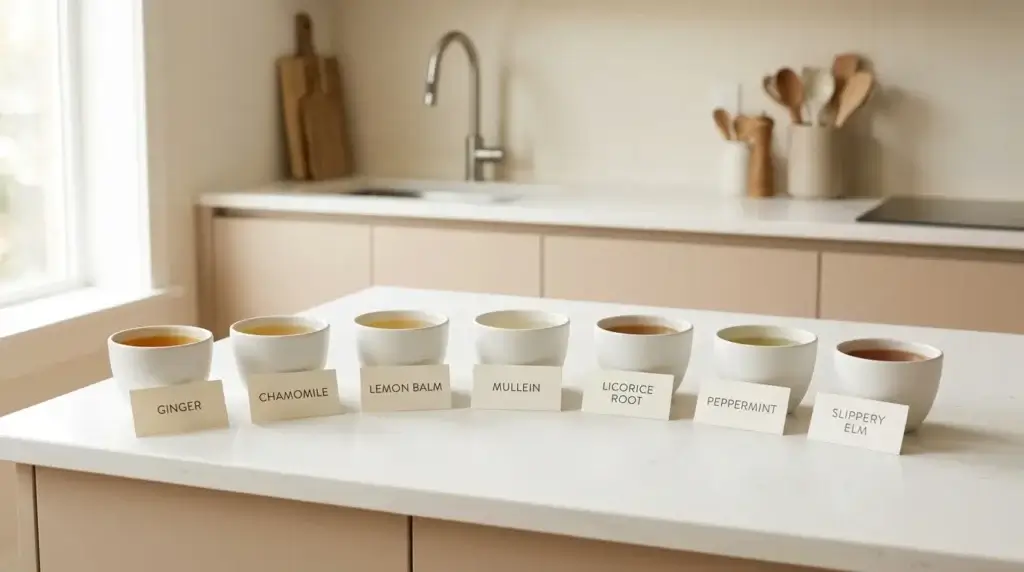
1. Ginger Tea — Best for Inflammation-Driven Pain
Why it works: Ginger contains gingerols and shogaols — compounds with potent anti-inflammatory and analgesic properties. They inhibit prostaglandin synthesis (the same mechanism as ibuprofen, though at gentler intensity) and reduce the inflammatory swelling that makes swallowing painful.
Best for: Sore throats caused by viral infections, where inflammatory swelling is the primary source of pain.
Clinical evidence: Multiple studies confirm ginger’s anti-inflammatory and analgesic effects. A 2020 study found ginger extract significantly reduced inflammatory markers comparable to pharmaceutical anti-inflammatories at equivalent doses.
How to use: 3–4 slices of fresh ginger steeped or simmered in hot water for 5–10 minutes. Fresh ginger is significantly more potent than powdered. Add honey and lemon for maximum effect.
For the full profile of ginger’s health benefits, see our ginger tea benefits guide.
2. Licorice Root Tea — Best for Coating and Soothing
Why it works: Licorice root contains glycyrrhizin and mucilage compounds that coat the mucous membranes of the throat with a protective layer, directly reducing irritation and the burning sensation of a sore throat. It also has documented antiviral and anti-inflammatory properties.
Best for: Dry, irritated sore throats where the main complaint is burning and scratching rather than swelling. Particularly effective for sore throats caused by acid reflux or persistent coughing.
How to use: Steep 1 teaspoon of dried licorice root in 240ml hot water for 10 minutes. Strain and sip slowly.
Safety note: Licorice root should not be consumed daily for extended periods — glycyrrhizin can raise blood pressure and cause potassium depletion with excessive long-term use. For short-term acute sore throat relief (3–7 days), it is safe for most healthy adults. Avoid if you have high blood pressure or are pregnant.
3. Chamomile Tea — Best for Pain Relief + Sleep
Why it works: Chamomile combines three mechanisms relevant to sore throats: anti-inflammatory flavonoids (apigenin) that reduce throat inflammation, mild analgesic properties that reduce pain perception, and a mild sedative effect through GABA receptor binding that helps you sleep while sick.
Best for: Sore throats that are disrupting sleep — chamomile addresses the throat pain and helps you rest simultaneously.
Clinical evidence: A 2010 study found chamomile tea inhalation reduced cold and flu symptoms including sore throat more effectively than steam alone, confirming both the aromatic and ingested benefits.
For the full chamomile profile including sleep research, see our chamomile tea benefits guide. For the best drinks to support rest when sick, see our best drinks for better sleep guide.
4. Peppermint Tea — Best for Numbing Throat Pain
Why it works: Menthol — peppermint’s primary active compound — activates cold-sensitive TRPM8 receptors in the throat, producing a numbing, cooling sensation that temporarily reduces the perception of pain. This is not anti-inflammatory; it is analgesic through sensory receptor activation — similar to how topical numbing gels work.
Best for: Acute sore throat pain where you need fast symptomatic relief. The menthol effect is immediate and noticeable.
Important warning: Peppermint relaxes the lower esophageal sphincter — avoid if your sore throat is caused by or accompanied by acid reflux or GERD, as it will worsen reflux symptoms. For people with GERD-related sore throat, chamomile or licorice root are safer choices.
See our peppermint tea benefits guide for the full profile including the acid reflux warning.
5. Mullein Tea — Best for Sore Throat with Cough
Why it works: Mullein’s saponins loosen and thin mucus (expectorant effect) while its mucilage directly coats inflamed throat mucous membranes (demulcent effect). This dual action is uniquely effective for sore throats that come with cough, congestion, or upper respiratory infection — where the coughing itself is causing additional throat irritation.
Best for: Sore throats caused by or accompanied by cough, bronchitis, or post-nasal drip.
Critical preparation note: Always strain mullein tea through a very fine mesh or coffee filter to remove the leaf hairs that can themselves irritate the throat.
See our mullein tea benefits guide for full preparation guidance.
6. Lemon Balm Tea — Best for Stress-Related or Viral Sore Throats
Why it works: Lemon balm has documented antiviral activity — particularly against herpes simplex viruses and other enveloped viruses that commonly cause sore throats. Its rosmarinic acid also has anti-inflammatory properties, and its anxiolytic effects help with the stress and anxiety that often accompany illness.
Best for: Sore throats with a viral cause, or when stress and anxiety are amplifying symptom perception.
See our lemon balm tea benefits guide for the full antiviral and calming research.
7. Green Tea — Best for Antibacterial + Antioxidant Support
Why it works: Green tea’s catechins — particularly EGCG — have documented antibacterial activity against Streptococcus mutans and other oral and throat bacteria. Multiple studies have found gargling with green tea reduces bacterial counts in the mouth and throat. Its polyphenols also have antiviral and antioxidant effects that support immune function during infection.
Best for: Bacterial sore throat (strep) support, or as a maintenance drink to reduce infection severity.
How to use for maximum throat benefit: Cool green tea to a comfortable temperature and gargle for 30 seconds before swallowing. The direct contact with throat tissue enhances the antibacterial effect beyond just drinking it.
The Single Most Effective Sore Throat Tea: Ginger + Honey + Lemon

If you make one sore throat tea, make this. The combination of fresh ginger (anti-inflammatory), raw honey (antimicrobial + coating), and lemon (vitamin C + astringent) is the most comprehensive natural sore throat remedy available in a single cup — addressing inflammation, bacterial load, throat coating, and immune support simultaneously.
The honey detail that matters most: Use raw honey, not pasteurized honey. Raw honey contains active enzymes — particularly glucose oxidase — that produce hydrogen peroxide when exposed to throat mucus, providing genuine antimicrobial activity. Pasteurized honey loses these enzymes during heat treatment. Manuka honey (rated UMF 10+ or higher) is the most potent option with the strongest documented antimicrobial activity.
The temperature detail that matters most: Add honey only after the tea has cooled to approximately 60–65°C. Adding honey to boiling water destroys the active enzymes that make raw honey therapeutically valuable. Hot enough to dissolve and feel soothing — not boiling.
How to sip it: Slowly. The slower you sip, the longer the honey, ginger, and lemon compounds remain in contact with the inflamed throat tissue. Resist the urge to gulp — treat each sip as a topical application.
Quick Reference: Best Tea by Sore Throat Type
| Sore throat cause | Best tea | Key mechanism |
|---|---|---|
| Viral infection, swelling | Ginger | Anti-inflammatory (gingerols) |
| Dry, irritated, burning | Licorice root | Demulcent — throat coating |
| Pain disrupting sleep | Chamomile | Analgesic + mild sedative |
| Acute pain, need fast relief | Peppermint | Menthol numbing effect |
| With cough or congestion | Mullein | Expectorant + demulcent |
| Viral cause suspected | Lemon balm | Antiviral (rosmarinic acid) |
| Bacterial / strep support | Green tea | Catechin antibacterial |
| All-purpose | Ginger + honey + lemon | Anti-inflammatory + antimicrobial |
What to Add to Any Sore Throat Tea

Regardless of which tea you choose, these additions consistently improve sore throat relief:
Raw honey (1 tablespoon): The most effective single addition. Antimicrobial, coating, and soothing. Add at 60–65°C, never into boiling water.
Fresh lemon juice: Vitamin C supports immune function, and lemon’s slight astringency reduces throat swelling by contracting inflamed tissue. Also improves the flavor of most herbal teas.
Cayenne pepper (small pinch): Capsaicin initially stimulates pain receptors but then depletes substance P — a neurotransmitter involved in pain signaling — from nerve endings. A small pinch in sore throat tea provides genuine analgesic benefit for some people. Start with a very small amount.
Fresh turmeric or ginger: Adding both to the same cup amplifies the anti-inflammatory effect — curcumin (turmeric) and gingerols work through overlapping anti-inflammatory pathways.
Apple cider vinegar (1 teaspoon): Its acidity may inhibit bacterial growth in the throat. Dilute well — undiluted ACV can irritate the esophagus.
Does Tea Actually Help a Sore Throat?
Yes — though with important context. Tea does not cure a sore throat caused by a bacterial infection such as strep. For strep throat (confirmed by a rapid test or throat culture), antibiotics are the appropriate treatment. Herbal tea provides supportive relief — reducing pain, inflammation, and bacterial load — but cannot replace antibiotic treatment when one is indicated.
For viral sore throats (the most common type, usually accompanying a cold or flu), herbal tea is a genuine primary intervention. There is no antibiotic treatment for viral infections, and most viral sore throats resolve within 5–7 days with supportive care. The right tea significantly improves comfort during this period.
When to see a doctor: If your sore throat is severe, lasts longer than 7 days, is accompanied by difficulty breathing or swallowing, high fever, or visible white patches on the tonsils — see a doctor rather than relying on herbal remedies. These may be signs of strep throat, tonsillitis, or other conditions requiring medical treatment.
Frequently Asked Questions
What is the best tea for a sore throat?
Ginger tea with raw honey and lemon is the most comprehensive natural sore throat tea — combining anti-inflammatory gingerols, antimicrobial raw honey, and vitamin C from lemon. For a dry, irritated sore throat, licorice root’s coating effect is most targeted. For a sore throat with cough, mullein is the most specific choice.
Does tea help a sore throat?
Yes — through multiple mechanisms: warm liquid relaxes the throat, steam loosens mucus, hydration keeps the throat moist, and herbal compounds provide anti-inflammatory, analgesic, antimicrobial, or demulcent effects depending on the tea chosen. Tea cannot cure bacterial sore throat (strep), but provides genuine relief for the most common type — viral sore throat.
Is green tea or ginger tea better for sore throat?
Different purposes. Green tea is better for antibacterial activity — gargling green tea reduces bacterial counts in the throat. Ginger tea is better for reducing inflammation and pain. For a viral sore throat with swelling and pain, ginger wins. For early-stage sore throat prevention or bacterial cause, green tea is more targeted.
Can I drink tea with a sore throat caused by acid reflux?
Yes — but choose carefully. Avoid peppermint tea (worsens reflux) and acidic teas like hibiscus. Choose chamomile (pH 6–7, anti-inflammatory), licorice root (specifically esophageal-protective), or ginger (anti-inflammatory without reflux risk). See our hibiscus tea and acid reflux guide for the full overview of safe and unsafe teas for GERD.
Is honey in tea good for a sore throat?
Yes — and specifically raw honey, not pasteurized. Raw honey contains active enzymes (glucose oxidase) that produce hydrogen peroxide in contact with throat mucus, providing genuine antimicrobial activity. Add honey only after the tea cools to 60–65°C — boiling water destroys the active enzymes.
How many cups of tea should I drink for a sore throat?
3–4 cups per day of your chosen sore throat tea during acute symptoms. Space them throughout the day — morning, midday, afternoon, and before bed. Each cup keeps the throat coated with honey and anti-inflammatory compounds for 2–3 hours.
What tea is good for strep throat?
Tea is supportive care for strep throat — not a primary treatment. Strep throat requires antibiotic treatment. While waiting for or alongside antibiotics, green tea’s catechins have antibacterial activity against streptococcal bacteria, and ginger + honey provides anti-inflammatory relief. Always see a doctor for suspected strep throat.
Key Takeaways
- The best tea for sore throat depends on the cause: ginger for inflammation, licorice root for coating/dryness, chamomile for pain + sleep, peppermint for fast numbing, mullein for cough + sore throat, lemon balm for viral causes
- The single most effective combination is fresh ginger + raw honey + lemon juice
- Raw honey is essential — pasteurized honey lacks the active enzymes that provide antimicrobial activity; add only after tea cools to 60–65°C
- Sip slowly — contact time between the soothing compounds and the throat tissue is what produces the relief
- Tea provides genuine supportive relief for viral sore throat but cannot replace antibiotic treatment for confirmed bacterial (strep) infection
- See a doctor if the sore throat is severe, lasts over 7 days, or comes with high fever or white patches on the tonsils
- 3–4 cups per day during acute symptoms; choose the tea that matches your specific symptoms from the table above