
Hibiscus tea is rich in colorful plant compounds called anthocyanins, which have antioxidant properties. This has led to growing interest in possible hibiscus tea benefits for skin, including questions about acne, skin aging, hydration and collagen.
However, there is an important distinction between what researchers know about individual compounds found in hibiscus, what has been observed with hibiscus extracts in laboratory studies, and what has actually been demonstrated in people drinking hibiscus tea.
At present, there is not strong clinical evidence showing that drinking hibiscus tea will clear acne, prevent skin aging or produce visible skin improvements within a specific number of weeks.
That does not mean hibiscus has no nutritional value. Instead, its potential role in skin health should be viewed as part of an overall diet rather than as a treatment or replacement for skincare.
In this guide, we’ll look at what the research suggests about hibiscus tea for skin, where the evidence is limited, and which popular claims should be treated cautiously.
How Hibiscus Tea Benefits Skin: The 4 Mechanisms
1. Anthocyanins and Antioxidant Activity
Hibiscus gets its deep red color largely from anthocyanins, a family of plant pigments with antioxidant properties.
Antioxidants are studied because they can interact with reactive oxygen species involved in oxidative stress. Oxidative stress is also relevant to skin biology and can be influenced by factors such as UV exposure and pollution.
However, there is an important limitation when discussing hibiscus tea benefits for skin: evidence that anthocyanins have antioxidant activity does not prove that drinking hibiscus tea protects human skin from UV damage or prevents visible skin aging.
Much of the research in this area involves isolated compounds, extracts, laboratory models or other anthocyanin-rich foods rather than ordinary hibiscus tea consumed as a beverage.
Therefore, hibiscus tea can be described as a source of antioxidant plant compounds, but it should not be considered a substitute for sunscreen or other proven sun-protection measures.
2. Vitamin C and Collagen
Vitamin C plays an important role in normal collagen formation and is an essential nutrient for skin health.
Hibiscus calyces can contain vitamin C, but the amount that ends up in a cup of hibiscus tea can vary considerably depending on the plant material, processing, storage and preparation method.
For this reason, hibiscus tea should not be presented as a reliable or major source of vitamin C unless the actual beverage has been analyzed.
More importantly, the fact that vitamin C contributes to normal collagen formation does not mean that drinking hibiscus tea has been proven to increase skin collagen or reverse age-related collagen loss.
For adequate vitamin C intake, foods such as fruits and vegetables remain more predictable dietary sources. Hibiscus tea can simply be enjoyed as part of an overall varied diet.
3. Quercetin, Inflammation and Acne
Hibiscus contains a variety of plant compounds, including flavonoids such as quercetin and related compounds, that have been studied for antioxidant and anti-inflammatory activity.
Inflammation plays an important role in acne and several other skin conditions. However, evidence that a compound has anti-inflammatory activity in laboratory research does not mean that drinking hibiscus tea has been proven to reduce acne or rosacea in people.
Some laboratory studies have also investigated antimicrobial effects of plant compounds against bacteria associated with acne. These findings should not be interpreted as evidence that hibiscus tea can treat or prevent acne.
At present, there is not enough clinical evidence to recommend hibiscus tea as an acne treatment.
If you enjoy hibiscus tea, it can be part of an overall balanced diet, but persistent, painful or severe acne should be evaluated by a healthcare or dermatology professional rather than treated with herbal tea.
4. Hibiscus Extracts and Collagen-Related Research
Some laboratory research has investigated whether compounds or extracts from hibiscus can affect matrix metalloproteinases (MMPs), enzymes involved in the breakdown and remodeling of proteins such as collagen.
These findings are scientifically interesting because collagen is an important structural component of skin.
However, laboratory experiments using hibiscus extracts are very different from drinking a cup of hibiscus tea. The concentration of compounds, method of exposure and biological conditions may not reflect what happens in the human body after drinking the tea.
At present, there is not enough human clinical evidence to conclude that drinking hibiscus tea prevents collagen breakdown, increases skin collagen or produces an anti-aging effect.
This is a good example of why potential biological mechanisms should be distinguished from demonstrated skin benefits in humans.
What Hibiscus Tea Can and Cannot Do for Skin
The potential skin benefits of hibiscus tea are often overstated online. Research on hibiscus compounds and extracts is interesting, but evidence from laboratory studies should not be treated as proof of visible skin improvements from drinking hibiscus tea.
| Claim | What the Evidence Actually Shows |
|---|---|
| Provides antioxidant compounds | Yes. Hibiscus contains anthocyanins and other plant compounds with antioxidant activity. |
| Protects skin from UV damage | Not established for drinking hibiscus tea. It should never replace sunscreen or other sun-protection measures. |
| Boosts collagen production | Not proven. Vitamin C is involved in normal collagen formation, but this does not establish that hibiscus tea increases skin collagen. |
| Reduces acne | Not proven in human clinical trials. Hibiscus tea should not be considered an acne treatment. |
| Improves skin hydration | There is not enough direct evidence to conclude that drinking hibiscus tea noticeably improves skin hydration. |
| Prevents skin aging or wrinkles | Not established. Laboratory findings involving antioxidants or hibiscus extracts do not prove an anti-aging effect from drinking the tea. |
| Produces visible results within weeks | No reliable timeline has been established for visible skin changes from hibiscus tea. |
| Replaces skincare products | No. Hibiscus tea should be viewed as a beverage, not as a replacement for evidence-based skincare or medical treatment. |
Bottom line: Hibiscus tea provides plant compounds that are scientifically interesting, but there is currently a substantial difference between potential biological mechanisms and proven visible skin benefits in humans.
How Long Does Hibiscus Tea Take to Improve Skin?
There is no established timeline for hibiscus tea to produce visible skin improvements.
Claims that hibiscus tea will improve acne, hydration, skin tone or wrinkles within a specific number of weeks are not supported by strong human clinical evidence.
Research on hibiscus includes studies of its plant compounds, antioxidant activity and concentrated extracts, but this does not establish that drinking hibiscus tea every day will produce visible skin changes after 2, 4, 8 or 12 weeks.
Skin appearance is influenced by many factors, including genetics, age, sun exposure, skincare, diet, hydration, sleep, hormones and medical conditions.
If you enjoy hibiscus tea, it can be included as part of a varied diet, but it is better to think of it as a beverage containing plant compounds rather than a treatment with a predictable skin-results timeline.
For concerns such as persistent acne, rosacea, unusual pigmentation or significant skin irritation, hibiscus tea should not replace appropriate skincare or professional medical advice.
How Much Hibiscus Tea for Skin Benefits?
There is no scientifically established amount of hibiscus tea per day that has been proven to improve skin.
Studies investigating hibiscus for other health outcomes sometimes use specific amounts or preparations, but those quantities should not be interpreted as a proven dose for acne, collagen, hydration or anti-aging benefits.
If you enjoy hibiscus tea, it can be consumed as part of your normal beverage routine according to your individual tolerance. Drinking more does not mean that you will obtain greater skin benefits.
Hibiscus may also affect blood pressure and may not be appropriate for everyone, particularly in larger amounts or alongside certain medications. If you have a medical condition, take medication, are pregnant or plan to consume hibiscus regularly in concentrated amounts, discuss it with a healthcare professional.
For general guidance about daily intake rather than skin-specific claims, see our how much hibiscus tea per day guide.
Hot vs Cold Hibiscus Tea for Skin Benefits
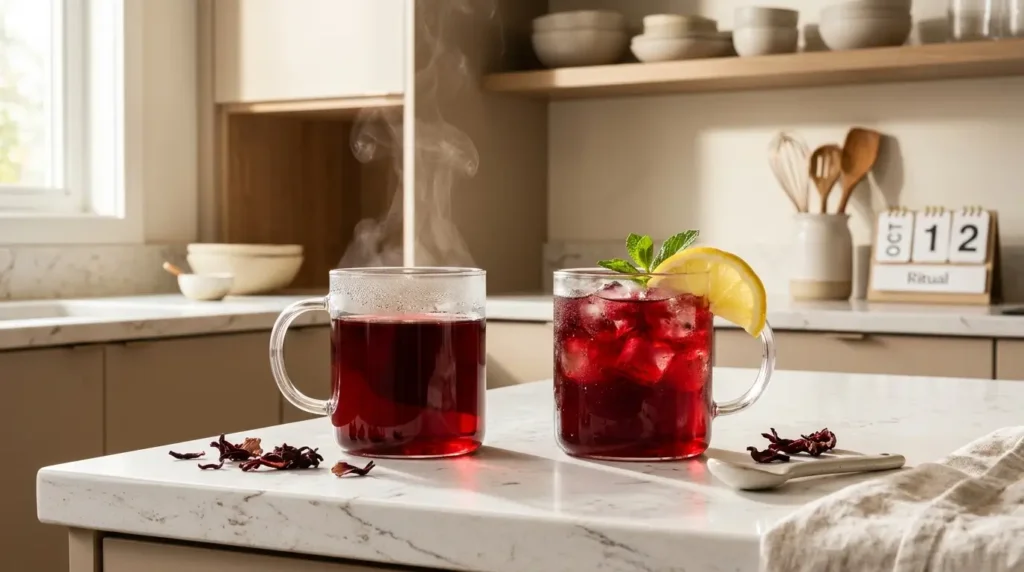
Both hot and cold hibiscus tea can contain anthocyanins and other plant compounds, but their exact concentrations can vary depending on the amount of hibiscus used, water temperature, steeping time and preparation method.
There is currently no good evidence showing that hot hibiscus tea provides greater skin benefits than cold hibiscus tea, or vice versa.
A stronger extraction of certain plant compounds does not automatically translate into better skin hydration, less acne, more collagen or slower skin aging.
For skin health, there is therefore no need to choose hot or cold hibiscus tea based on a supposed anti-aging or antioxidant advantage.
Choose the preparation you enjoy and tolerate best.
For a detailed comparison of preparation methods, see our hibiscus tea hot or cold guide. You can also see our how to make hibiscus tea guide for preparation instructions.
Hibiscus Tea for Skin vs Other Herbal Teas
Hibiscus is not the only tea studied for plant compounds that may be relevant to skin health. Green tea, spearmint, chamomile and other herbal teas have also attracted research interest.
However, comparing them as treatments for specific skin conditions can be misleading because the amount and quality of human evidence vary considerably.
| Tea | Compounds Commonly Studied | What to Keep in Mind |
|---|---|---|
| Hibiscus | Anthocyanins and other polyphenols | Contains antioxidant plant compounds, but direct evidence for visible skin benefits from drinking hibiscus tea is limited. |
| Green tea | Catechins such as EGCG | Widely studied, but evidence about a compound or extract should not automatically be applied to ordinary tea consumption. |
| Spearmint tea | Polyphenols and other plant compounds | Has been studied in limited research involving hormones, but it should not be considered a treatment for hormonal acne. |
| Chamomile tea | Flavonoids such as apigenin | Commonly consumed as an herbal tea, but drinking it has not been established as a treatment for rosacea or sensitive skin. |
| Red clover tea | Isoflavones | Isoflavones have attracted research interest, but red clover tea should not be presented as a proven treatment for menopausal skin aging. |
The most appropriate tea therefore depends primarily on your taste, caffeine preference and individual tolerance rather than on claims that one tea specifically treats acne, wrinkles, rosacea or other skin conditions.
If you are interested in the research around spearmint specifically, see our spearmint tea benefits guide.
Can You Use Hibiscus Tea Topically for Skin?
Hibiscus extracts are sometimes included in commercial skincare products, but this does not mean that homemade hibiscus tea has the same properties or safety profile as a formulated skincare product.
Commercial products are developed with controlled concentrations, pH levels, preservatives and other ingredients designed for use on the skin. A cup of homemade hibiscus tea does not have these controls.
Although DIY hibiscus toners are popular online, there is not enough clinical evidence to recommend homemade hibiscus tea as an acne treatment, exfoliant, skin-brightening treatment or alternative to products containing established skincare acids.
Hibiscus preparations can also be acidic, and applying an unformulated acidic liquid to the face may cause irritation, particularly on sensitive, dry or damaged skin.
For these reasons, it is better to choose a properly formulated skincare product if you want to use hibiscus topically rather than assuming that drinking tea can safely be turned into a facial toner.
For general information about precautions associated with hibiscus, see our hibiscus tea side effects guide.
Hibiscus Tea for Skin — Practical Tips
If you enjoy hibiscus tea, there is no need to follow a special skin-health protocol. The most useful approach is to include it as one beverage within an overall balanced diet.
Drink it according to your tolerance: There is no established number of cups per day required to obtain skin benefits. More hibiscus tea does not necessarily mean better results.
Limit added sugar: Unsweetened hibiscus tea is naturally low in calories. If you prefer it sweeter, use an amount that fits your overall diet rather than assuming that completely avoiding sugar will directly improve the effects of hibiscus on your skin.
Add lemon for flavor if you enjoy it: Lemon can add flavor and vitamin C, but it has not been established that adding lemon to hibiscus tea produces greater skin benefits.
Drink it whenever it suits your routine: There is no evidence that drinking hibiscus tea during particular hours of the day provides additional UV protection or greater skin benefits.
Think about your overall diet: Skin health depends on many factors. A varied diet that provides adequate protein, essential fatty acids, vitamins, minerals, fruits and vegetables is more important than relying on any single beverage.
Continue proven skin protection: Hibiscus tea should not replace sunscreen, appropriate skincare or treatment recommended for a skin condition.
For a broader discussion of hibiscus, see our hibiscus tea benefits for women guide.
Frequently Asked Questions
Is hibiscus tea good for skin?
Hibiscus tea contains anthocyanins and other plant compounds with antioxidant properties. These compounds are scientifically interesting, but there is not enough human clinical evidence to conclude that drinking hibiscus tea produces specific visible skin benefits. It can be enjoyed as part of a varied diet but should not replace skincare or medical treatment.
What are the benefits of hibiscus tea for skin?
Hibiscus contains antioxidant plant compounds, including anthocyanins. However, many claims about hibiscus tea benefits for skin are based on research involving individual compounds, laboratory studies or concentrated extracts rather than people drinking hibiscus tea. Benefits such as reducing wrinkles, increasing collagen or clearing acne have not been firmly established.
Does hibiscus tea improve skin?
There is not enough direct clinical evidence to say that drinking hibiscus tea noticeably improves skin tone, hydration, texture or wrinkles. Skin health is influenced by many factors, including diet, sun exposure, skincare, genetics, age and overall health.
Does hibiscus tea help with acne?
Hibiscus tea has not been proven to treat or prevent acne. Although hibiscus contains compounds studied for antioxidant and anti-inflammatory activity, this does not establish that drinking the tea reduces acne in people. Persistent or severe acne should be discussed with a healthcare or dermatology professional.
How much hibiscus tea should I drink for skin benefits?
There is no scientifically established number of cups of hibiscus tea per day that has been proven to improve skin. If you enjoy hibiscus tea, drink an amount that fits your normal routine and individual tolerance rather than following a specific skin-health dose.
How long does hibiscus tea take to work for skin?
There is no established timeline for hibiscus tea to produce visible skin changes. Claims that results should appear after 2, 4, 8 or 12 weeks are not supported by strong clinical evidence involving people drinking hibiscus tea.
Can hibiscus tea be used on skin?
Commercial skincare products may contain formulated hibiscus extracts, but homemade hibiscus tea is different. It can be acidic and may irritate some skin types. There is not enough evidence to recommend homemade hibiscus tea as a facial toner, exfoliant, acne treatment or substitute for formulated skincare products.
Does hibiscus tea help with anti-aging?
Hibiscus contains antioxidant plant compounds, but drinking hibiscus tea has not been proven to prevent wrinkles, increase skin collagen or slow visible skin aging. Laboratory findings involving hibiscus compounds or extracts should not be interpreted as proof of an anti-aging effect from drinking the tea.
Key Takeaways
- Hibiscus tea contains anthocyanins and other antioxidant plant compounds, but direct human evidence for specific skin benefits from drinking the tea remains limited.
- Research involving hibiscus extracts, isolated compounds or laboratory models should not be treated as proof that drinking hibiscus tea improves skin.
- Hibiscus tea has not been proven to clear acne, increase skin collagen, prevent wrinkles or protect skin from UV damage.
- There is no established timeline showing that hibiscus tea produces visible skin improvements after a specific number of weeks.
- There is no scientifically established number of cups per day required to obtain skin benefits.
- Hot and cold hibiscus tea can both be enjoyed; neither preparation has been proven to provide superior skin benefits.
- Homemade hibiscus tea should not be considered equivalent to a formulated skincare product or used as a replacement for evidence-based skincare.
- Hibiscus tea can be part of a varied diet, but overall nutrition, sun protection and appropriate skincare are considerably more important for maintaining healthy skin.
- Persistent acne, rosacea, unusual skin changes or other significant skin concerns should be evaluated by an appropriate healthcare professional.